-

La forma stradivariana - Fazioli Ernesto
-

Teca museale con gli arnesi usati da Antonio Stradivari. Cremona, Museo Civico - Fazioli Ernesto
-

Liutaio al lavoro - Fazioli Ernesto
-

Bottega del liutaio R. Muncher - Fazioli Ernesto
-

Il liutaio Munchen al lavoro nella sua bottega - Fazioli Ernesto
-

Liutaio al lavoro - Fazioli Ernesto
-

Veduta del salone superiore, sede della Mostra di Liuteria antica. Cremona, Palazzo Cittanova - Fazioli Ernesto
-

Violino Stradivari Hellier - Fazioli Ernesto
-

Modelli e arnesi di Antonio Stradivari. Cremona, Museo Civico - Fazioli Ernesto
-

La Principessa Maria Josè di Piemonte visita la Mostra di Liuteria Moderna a Palazzo Soranzo con il liutaio Sacconi - Fazioli Ernesto
-

La Liuteria di Antonio Stradivari nell'anno 1690 - Fazioli Ernesto
-

La teca centrale con gli strumenti di Antonio Stradivari. Cremona, Museo Civico, sala stradivariana - Fazioli Ernesto
-

Mostra di Liuteria antica cremonese. Il Principe di Piemonte Umberto II e l'Onorevole Farinacci alla mostra. Cremona, Palazzo Soranzo - Fazioli Ernesto
-

Mostra di Liuteria antica cremonese. La visita del Principe di Piemonte Umberto II all'inaugurazione - Fazioli Ernesto
-

Mostra di Liuteria antica cremonese. L'Onorevole Farinacci davanti al violino di Paganini. Cremona, Palazzo Cittanova - Fazioli Ernesto
-

La sala stradivariana del Museo Civico di Cremona - Fazioli Ernesto
-

Mostra di Liuteria antica cremonese. Operai al lavoro per l'allestimento. Cremona, Palazzo Cittanova - Fazioli Ernesto
-

Un lato della teca con gli strumenti e arnesi di Antonio Stradivari. Cremona, Museo Civico, sala stradivariana - Fazioli Ernesto
-

Mostra di Liuteria antica cremonese. Cremona, Palazzo Cittanova - Fazioli Ernesto
-

Violino Stradivari Alba "1719" - Fazioli Ernesto
-

Magazzino di liuteria - Fazioli Ernesto
-

Magazzino di liuteria - Fazioli Ernesto
-

Aspetti del lavoro in Lombardia. Artigiani. Pierre Bohr, liutaio - Costa Marco
-

Aspetti del lavoro in Lombardia. Artigiani. Stefano Solari, liutaio - Costa Marco
-

Aspetti del lavoro in Lombardia. Artigiani. Stefano Solari, liutaio - Costa Marco
-

Liuteria cremonese. Maestri. Francesco Mario Bissolotti - Lorenzo Pizzi
-
Liuteria cremonese. Maestri. Gio Batta Morassi - Lorenzo Pizzi
-
Liuteria cremonese. Saper Fare. Giorgio Grisales - Lorenzo Pizzi
-
Liuteria cremonese. Saper Fare. Luisa Vania Campagnolo - Lorenzo Pizzi
-
Liuteria cremonese. Saper Fare. Apprendistato - Lorenzo Pizzi
-
(?)


1929


1930

1937


1950


1992


2011


Cremona Luthiery
The background knowledge and expertise of a traditional luthier from Cremona treasures the ability to make bowed string instruments such as violins, violas, cellos, double basses. Crafting these instruments takes up to many months and involves a complex series of work phases that require high competence, from the choice of wood to its responses during processing. Each stage involves the use of numerous tools and specific working techniques that must be learned and incorporated. All the instrument parts are only millimeter- thick and have a delicate geometrical rapport which changes according to the characteristics of the wood. Each working phase influences the next one, and it is necessary to know how to adapt the different working phases according to the outcome of the previous ones. The most difficult endeavor is to obtain perfect symmetries of the lines that make up the instrument. To reach such climax you need trained eyes and expert hands; you need to adjust lines according to the different phases of the work and according to results of the previous stages. This expertise is exclusively manual but requires also deep knowledge of materials and working techniques.
These competences have been passed on since XVI century, from maestro to trainee, from father to son and have been acquired by practice. These skills, in fact, more than relying on words, are transmitted by body, visual and tactile experiences. They are perfected by practice and are learnt when the maestro shows his techniques with practical examples and the trainee is able to grasp by looking at his working skills. Traditional luthiery in Cremona is the only handcraft to have preserved characteristics and processes which can be traced back to the 1600 century artisans.
Still today in Cremona the luthier skills are connected to manual expertise, a long apprenticeship, a workshop run by a maestro alone, sometimes helped by a couple of trainees, the use of material (wood, glue, varnish) and traditional tools. The preservation of original techniques, the excellent quality of finished products and the assistances of the category corporation (Consorzio Liutai Antonio Stradivari. CNA, Confartigianato e Associazione Liutaria Italiana) are also important and to be mentioned. Modern tools differ very little from traditional tools which have always been present the luthiers' workshops in Cremona. The handcrafted product is currently mainly carried out in all its phases by the master craftsman or his collaborators, but some instruments can be the result of the collaboration between master and apprentices. The quality is guaranteed by the master, who checks each step of the manufacturing process, maintaining the high quality of the instrument, both in terms of beauty and sound performance. The use and acquisition of semi-finished products could threaten the quality of the work, because it does not allow for a substantial modification of a previous manufacture. The product quality cannot exclusively be related to techniques and procedures acquired by studying, but are connected to the experience of the handicraftsman, his manual skills and esthetical sense, his expertise which comes from years of hard work, success, failures, experiments and confrontations with other luthiers. Only through all these stages excellence can assured. Luthiers in Cremona are helped to reach such high standards thanks to the fact that the city hosts a prestigious school and the presence of many workshops which increase the chances of having experiences.
On 5 December 2012, the knowledge and know-how of violin making was inscribed in the Representative List of the Intangible Heritage of Humanity by UNESCO. In fact, traditional violin making is not just an artisan trade, but it is an element that strongly characterizes the city of Cremona and which produces a strong sense of belonging in the people of Cremona. Furthermore, the strong presence of international students in the International School of Violin Making and the high number of luthiers of foreign origin present in Cremona, combined with the wide circulation of musicians in the city, connotes the city of Cremona as a place of strong intercultural dialogue.
HISTORICAL-ANALYTICAL NOTES
The origins of the violin have not been defined unequivocally, but we know that Cremona immediately stood out thanks to the work of Andrea Amati (1505). His heirs were his sons Antonio and Gerolamo and his grandchildren Nicolò and Gerolamo. When Nicolò died in 1684 the predominance of the luthiery in Cremona got in the hands of the Guarnieri family, whose forefather was Andrea (1623-1698), an apprentice by Nicolò. This family activity carried on for more than half a century, both in Cremona and in other towns in northern Italy, tanks to the work of Andrea's sons, Pietro and Giuseppe -called "filius Andreae" - and to Giuseppe's son, Giuseppe "del Gesù" (1698-1744), the most famous member of this family. Contemporary of the last Guranieri member, Antonio Stradivari got the supremacy in the manufacturing of high quality instruments. At first he looks back at Amati's canons, then he introduces changes to the sounding board and to the bowlback. In his workshop his two sons, Francesco and Omobono used to work. A valuable family of the period is also the Rugeri family, among which stands out Vincenzo, whose production is placed between 1680 and 1717 approximately. Than luthiery in Cremona started declining, triggered by some luthiers who moved to other cities in the north of Italy, by a sharp decrease in the demand of new instruments and competition increase. Some members of the Bergonzi family, Lorenzo Storioni and the Ceruti dynasty shall be here mentioned. In Cremona the last follower of Enrico Ceruti is Gaetano Antoniazzi (1825-1897) who is also responsible for the final move of the luthiery school to Milan. Up to modern times, luthiery in Cremona can be described as poor; the most important exponents being Pietro Grulli (1831-1898), Aristide Cavalli and Giuseppe Beltrami (1900 -1930s) who worked on serial violins, of poor quality and having little or no relations at all with the classical cremonese luthiery expertise.
The rebirth of violin making in Cremona sees a key date: 1937. In fact, it is on this date that the celebrations for the bicentenary of the death of Antonio Stradivari and the establishment of the International School of Violin Making take place. The contribution of Maestro Simone Ferdinando Sacconi has been fundamental. He rediscovered the old Stravidari skills and techniques and was appointed by the School and the City Council to teach them again. These bodies allowed old luthiery to be pass on into modern luthiery. The numerous workshops guarantee outstanding quality, thanks to mutual collaboration, circulation of knowledge , expertise and protection from competitors. Numerous institutions also contribute to the preservation and enhancement of Cremonese violin making (see related fields).
LEARNING AND TRANSMISSION
In Cremona luthiery is learnt first of all at the Scuola Internazionale di Liuteria, a highly qualified professional education center in the field of stringed instrument construction and in the tradition of the ancient Cremona school. Beyond the theoretical subjects such as physics, chemistry and drawing, the central nucleus of learning is made up of the laboratories, in which the student learns the various stages of processing, from the sharpening of the tools to the making of the instrument. In order to learn how to build an instrument, the incorporation of numerous gestures, diversified from one tool to another, from one processing stage to another, and the refinement of the senses to verify one's work is essential.The relationship maestro-trainee goes through imitation and repetition rather than through verbal explanations.
In some cases students enter school having former education lernt in their family. In other cases they have studied as carvers or cabinet-makers and therefore are endowed with some general skills on carving wood.
Thanks to the availability of most of the luthiers, the students of the School usually attend the workshops, where they observe the luthiers at work and bring their works in progress to collect suggestions from the luthiers. In addition to the school teachers, therefore, it is thanks to the collaboration of all the luthiers that young people can be trained in the best possible way, according to the Cremona tradition.
Once the schooling has been completed, generally the new graduates (who have different ages, starting from 19 if they start the course immediately after the lower secondary schools) go on as apprentices to a Cremona workshop or abroad.
The professional training of the School is supported by the training of Cr-Forma - Special Company for professional training, which in 2014 launched the IFTS project for acoustic tuning of stringed instruments and the course for Technician of musical instrument restoration.
Furthermore, students who to deepen the study of restoration can attend the single-cycle master's degree course in Conservation and restoration of cultural heritage, specific for Musical instruments and technical and scientific tools, established in 2017 by the University of Pavia-Cremona branch (the only course of this profile in Italy).
It should also be emphasized that learning continues throughout life, first of all in the workshop as apprentices and then as masters, not only through practice in the workshop but also thanks to the intense exchange of information between luthiers. In fact, the confrontation with the other luthiers and the continuous training that offers the condensation in Cremona of many musical and luthier realities is fundamental. Furthermore, the Violin Museum organizes numerous in-depth meetings and various temporary exhibitions which allow the masters to study new instruments up close.
The Violin Making District programs training activities for professional luthiers regarding the chemistry of lutherie materials and acoustic physics. The restoration course of the Department of Musicology and Cultural Heritage opens various organological and restoration seminars to the attendance of professional luthiers.
COMMUNITY
From the latest analysis of the sector in 2016, there are 154 active luthiers' workshops, a unique concentration in the world, which employ around 197 people. The workshops are mainly individual, but given that some have up to 5/6 apprentices, it is estimated that the actual number of operators reaches 230-250 units. 42% of Cremona's shops have a foreign owner. Among the countries of origin, Japan, South Korea and France. Just under 40% of the shops with foreign owners were born only during the decade 2006-2016. Of the 197 active people, 18 are women, therefore 4 more than in the 2011 survey. The International School of Violin Making is attended by a higher percentage of women, who probably prefer to return to their country of origin after completing their studies. There are several organizations and associations to which the luthier craftsmen belong: the Italian Lutherie Association (A.L.I.) born in Cremona in January 1980 with the sole purpose of providing cultural and technical assistance to its members; the “A. Stradivari” Cremona born in 1996 with the aim of promoting and enhancing the contemporary Cremonese violin making, which operates in respect of the artisan tradition and has commercial purposes and the promotion of Cremonese violin making in the world. From the point of view of the "trade associations", there are two main associations to which luthiers belong: CNA and Confartigianato, with the task of protecting the sector of artistic craftsmanship. Such a high concentration of shops has a strong impact on the city of Cremona, both because it characterizes the urban fabric and because, with its international attraction for both professionals and tourists, it contributes to the construction of a sense of belonging to the city.
PROMOTIONAL ACTIONS
Museo del violino is dedicated to luthiery from its origins to modern times. This museum puts together three collections, namely the Collezione degli Archi di Palazzo Comunale (one of the most important collections of cremonese luthery), the instruments collection of the Concorso triennale di liuteria Cremonese and the collection of the former Museo Stradivariano (the initial nucleus is the Cerami collection, donated to the Municipality in 1893, containing some artifacts that belonged to Antonio Stradivari; the most relevant part is the material from Ignazio Alessandro Cozio, count of Salabue (1755-1840), purchased in 1920 by the Bolognese luthier Giuseppe Fiorini and donated by him to the Municipality of Cremona in 1930. A unique corpus in the world made up of wooden shapes, paper models and various tools that belonged to the great Cremonese luthier Stradivari.The collection also includes numerous bowed and plucked instruments from the 17th, 18th, 19, and 20th century).
Museo del violino promotes Cremonese violin making through exhibitions and conferences. It also organizes concerts and auditions of the instruments from the collection in its extraordinary concert hall. The Museum in managed by the Violin Museum Foundation, which is the result of the transformation of the Antonio Stradivari Cremona Foundation, which has been organizing the triennial international violin making competition since 1976 and which promotes "Friends of Stradivari", a worldwide association of all those who own, use or keep of classical Cremonese violin making, which promotes events of various types. Both actions are continuing under the aegis of the Violin Museum Foundation.
The Museum houses the Arvedi non-invasive analysis laboratory of the University of Pavia and the Musical Acoustics Laboratory of the Milan Polytechnic, which conduct high-level scientific research on the instruments in the Museum's collection and on the instruments of Cremonese luthiers, which have a extensive international dissemination.
The Ponchielli Theater Foundation plays a fundamental role, in particular with the Monteverdi Festival, the Walter Stauffer Foundation, which finances many activities related to violin making and organizes specialization courses for young musicians with renowned masters, and the Chamber of Commerce, which since more than ten years has been organizing - or has been collaborating in the organization of - musical festivals and training opportunities for string instrumentalists in Cremona.
The presence of musicological courses at the University of Pavia's Department of Musicology and Cultural Heritage (which is settled in Cremona), and the master's course in Music and Acoustic Engineering at the Milan Polytechnic (Cremona's branch) also contribute to keeping Cremona at the center of the gaze of musicians, musicologists and industry insiders at a international.
Finally, the Ente Fiera organizes "Mondomusica" - the most important annual international violin making fair which brings sector operators from all over the world to Cremona. All these activities allow for a constant and numerous presence of high-level musicians from all over the world, implementing that relationship between luthiers and musicians which is fundamental for maintaining a high level of construction quality.
PROTECTIVE MEASURES
Protection and safeguarding of Cremonese violin making are guaranteed by various components. In the first place from the numerous violin making workshops: a knowledge that strongly connotes the Cremona identity and a meeting point of different nationalities and cultures at the same time. Secondly, from the Cremona system of training, knowledge and cultural offerings in the luthier and musical fields.
The inscription of the "Traditional violinmaking in Cremona" in the Representative List of the Intangible Heritage of Humanity has led to further attention being paid to safeguarding the element. The candidacy meant that the asset was included in the R.E.I.L. and in the national inventory of the ICCD of the MiC through 15 BDI files documenting the processing stages of the instrument , the learning method in the International School of lutherie and deepen some significant elements of lutherie knowledge (creation of varnish, expertise).
In 2017 the Municipality of Cremona, with the support of the Cariplo Foundation and the Lombardy Region, transformed the Cultural District of the Municipality into a Violin Making District. It supports the musical culture and violin making of Cremona, coordinating the entities that in the city deal with education, training and research in the musical and violin making fields. The violin making district involves the main educational and cultural institutions of the city (Violin Museum Foundation, International School of Violin Making, Department of Musicology and Cultural Heritage of the University of Pavia, Milan Polytechnic – Cremona Territorial Pole, Special Company for professional training "Cr. Forma", the scientific laboratories at the Violin Museum of the University of Pavia and the Polytechnic of Milan) and all interested luthiers. The objectives of the District are the safeguarding of luthier "knowledge and know-how" through the consolidation of relations between luthiers and the District's partners, the study of the heritage of the Civic Lutherie Collections, the growth of Cremona's attractiveness nationally and internationally, the innovation in the productivity. 70 luthiers have recognized in the District a concrete possibility of updating and continuing high-level training. Thanks to the numerous meetings and moments of exchange, a community of Masters is being created, animated by the desire to consolidate knowledge and skills for the benefit of contemporary Cremona lutherie. Furthermore, the Municipality of Cremona has set up a UNESCO Office which is working on the Safeguarding Plan of Cremona's violinmaking know-how. The Safeguarding Plan was born from a long process which, from 2016 to 2021, involved the cultural and educational institutions gathered in the Cultural District of the city of Cremona, the Chamber of Commerce of Cremona, the trade associations, the Consorzio Violin makers, CremonaFiere, the 'Claudio Monteverdi' Cremona Conservatory, the Ponchielli Theater. In the first half of 2021 the aims, setting and development of the plan were shared, topics covered by the individual work sessions hypothesized, defining the contribution and the contribution that each of the subjects of this extensive network will bring to the work and implementation of future safeguard measures. The preparatory works have laid the foundations for a process of consultation and involvement of the whole Cremona community, with its institutions, trade associations, its craftsmen. The sharing of a first draft of the program made it possible to collect criticisms, suggestions and proposals from all the subjects involved. Particular attention was paid to the involvement of the luthier community, so that everyone could have the floor, with the aim of placing the lutherie community in its diversity at the centre, in an approach that was as inclusive as possible. A work that was deepened and systematized thanks to a questionnaire, released in the summer of 2021 and today the basis of a new scheduling of work sessions aimed at drawing up a Safeguard Plan.
To learn more
Web Sites
Bibliography
Strumentario. Il costruttore di strumenti musicali nella tradizione occidentale.
Marsilio 2008
E furono liutai in Cremona. Dal rinascimento al romanticismo, quattro secoli di arte liutaria
Consorzio Liutai e Archettai Antonio Stradivari 2000
Material resources
Old, modern and contemporary strings instruments; exhibits from the civic lutherie collections preserved at the Violin Museum, lutherie work tools.
Produced by
Università degli Studi di Pavia - Dipartimento di musicologia e beni culturali - Fulvia Caruso
Scientific Advisor
Fulvia Caruso
Release Date
13-NOV-2013 (Alessandra Corna)
Last update
07-MAR-2023 (Fulvia Caruso)
Tweet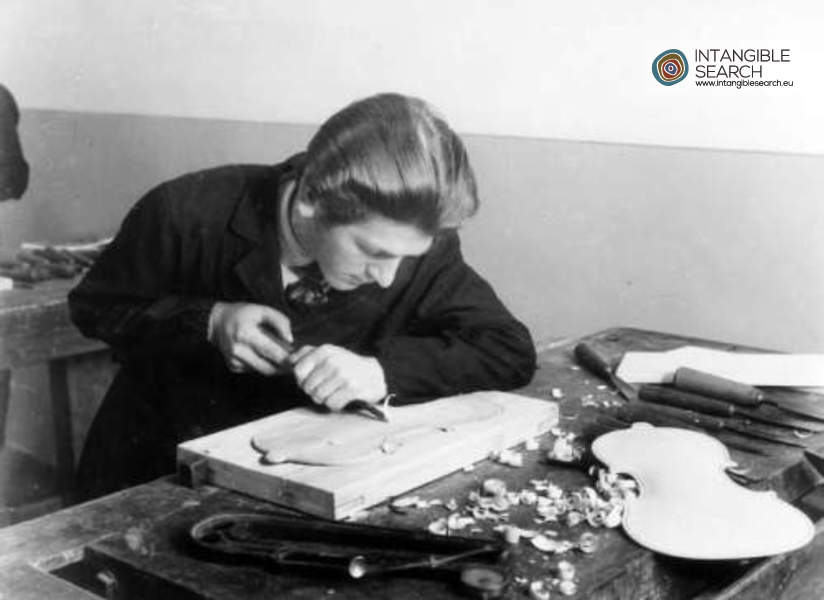
From Community
Tell us about it