-

Viticoltura eroica in Valtellina. Casa vinicola Nino Negri - Trame Metropolitane - Enece Film
-
Viticoltura eroica in Valtellina. Casa vinicola Nino Negri - Trame Metropolitane - Enece Film
-
Viticoltura eroica in Valtellina. Casa vinicola Nino Negri - Trame Metropolitane - Enece Film
-
Viticoltura eroica in Valtellina. Casa vinicola Nino Negri - Trame Metropolitane - Enece Film
-
Viticoltura eroica in Valtellina. Casa vinicola Nino Negri - Intervista a Casimiro Maule - Trame Metropolitane - Enece Film
-
Viticoltura eroica in Valtellina. Azienda Agricola Terrazzi Alti di Siro Buzzetti - Trame Metropolitane - Enece Film
-
Viticoltura eroica in Valtellina. Azienda vinicola Alfio Mozzi - Trame Metropolitane - Enece Film
-
Viticoltura eroica in Valtellina. Azienda vinicola Alfio Mozzi - Trame Metropolitane - Enece Film
-
Viticoltura eroica in Valtellina. Azienda vinicola Alfio Mozzi - Trame Metropolitane - Enece Film
-
Viticoltura eroica in Valtellina. Valtellina Wine Trail - Trame Metropolitane - Enece Film
-

Vigneti nella zona di Chiuro - Elisa Piria
-

Vigneti nella zona di Chiuro - Elisa Piria
-

Frazione Baruffini - Diego Ronzio
-

Frazione Baruffini - Diego Ronzio
-

Locanda Altavilla - Diego Ronzio
-
Viticoltura eroica in Valtellina. Storie di Vite - Federica Riva
-

Vigneti nella zona di Teglio - Federica Riva
-

Vigneti nella zona di Teglio - Federica Riva
-

Jonatan Fendoni. Legatura con salice - Federica Riva
-

Vigneti nella zona di Teglio - Federica Riva
-

Jonatan Fendoni. Legatura con salice - Federica Riva
-

Vitigni - Federica Riva
-

Vitigni - Federica Riva
-

Vigneti nella zona di Teglio - Federica Riva
-

Vigneti nella zona di Teglio - Federica Riva
-

Vigneti nella zona di Teglio - Federica Riva
-
2014

2015


2016


Heroic Vine-Growing in Valtellina
We can talk of heroic vine-growing when the landscapes presented a particular orographic-environmental configuration: mountain contexts with which the rural communities have measured themselves over the centuries, drawing those terracing that are today the main distinguishing element, a tangible heritage and a special knowledge that man has created by designing the landscape to produce resources. Today, their maintenance is closely linked to the vine-growing: the morphology of the soil implies a great job during the course of the years. The building of the dry-stone walls is handmade. The maintenance of the tiny plots is very laborious: when the ground is moved, it must be thrown from a terrace to the upper one, and then until to the top. Heroic vine-growing is not reducible to a simple aesthetic definition of landscape, it refers to a rural context exposed to particularly difficult working conditions, which have required enormous investments for the vine-growers communities.
Even with the advent of innovations and mechanical aids, we have the same conditions today. The today's vine-growers have many professional and ethical commitments: conservation and protection of the landscape that has represented, for the generations from which many descend, the only way of subsistence. Today, the new generations consciously choose to restart the cultivation of the family vineyards. In a fragile territory as Valtellina, the role of viticulture is more important than elsewhere, as well as for cultural and economic aspects, also for the protection of the landscape. Jonatan Fendoni, a young wine-grower "We are a group of friends who have decided to work the land. We have recovered the old seeds; we recover the abandoned terraces and the vineyards. We do it as a passion, outside of our work and we self-finance these activities”.
Two factors give advantage to Valtellina vine-growing: the climate and the nature of the land. We can speak of a microclimate “valtellinese”, since this area is protected from the perturbations, from the cold winds of the north and from the warm and humid ones of the south. The important ventilation phenomena, the mitigating influence of the Como Lake favor vine-growing, in a territory apparently hostile to the cultivation of it. The soil, the part of the land that interacts with the root system of plants, was created partly from the degradation of the rocks and partly due to the job of the Valtellina farmers over the centuries. The vine-growing is a constant of Valtellina agriculture and represents a symbol of it. Siro Buzzetti, another vine-grower, explains: "The vine-growing in Valtellina is not an intensive crop, there are many open spaces, many uncultivated area, and the impact of crops on the territory is extremely discreet. There are always zones where we do not grow, and therefore we maintain biodiversity and the landscape balance. This is what we do in Valtellina. The sun warms the rock and releases heat during the night, but it is never a suffocating heat because the Como Lake and the Alps create a thermal gradient. There is always ventilation and our bunch is like a cloth spread on the balcony of the house, it is aired and dries".
Still today, there is a separation between the bottom valley vine-growing, called "oppolo", and the cultivations on the south mountainside. The vines coming from the flat areas are for family consumption, while the commercial diffusion is limited to the products of the mountainside vine-growing. These are the areas that best express the specificity of Valtellina vine-growing. Here the prevailing technique is defined as "vigna spessa": low rows, close together, not interposed to other types of crops. As for the inclination it is almost impossible to access with large agricultural tools; the work is mainly carried out handmade, with the hoe or with very small plows. A new cultivation method has been adopted to use small tractors: while traditionally the vine plants were arranged according to a north-south orientation, along the line of maximum slope (defined as "a ritocchino"), today some plots adopt the east-west (defined as "giropoggio”).
Until the middle of the last century, vine-growing was the exclusive cultivation and sometimes associated with other plants. Other types of crops such as rye, millet, fruit trees and vegetables were alternated in the inter-rows. Traditional breeding provided that the plant was tied with one or more stems to a vertical wooden support. The branches were oriented and folded along horizontal supports (in variable numbers), also made of wood. Vine-growing was also made along the dry-stone walls, to increase the area of cultivation. Nowadays we have only vine-growing, as a single crop; only in abandoned or recovered fields it is possible to see that old organization of associated cultivations.
Among the traditional methods of pruning, one of the recurrent in Valtellina is the so-called "alla Cappuccina", better known as the "archetto alla valtellinese". The ligature with the willow is one of the most fascinating knowledge, for the ability it requires, and that can be explained only by the observation of who this gesture has been doing for years, like the expert vine-growers. Nowadays we can notice some innovation in traditional forms of vine-growing, introduced by the youngest vine-growers. The excessive length of the shoots and their weakening has been solved with shorter pruning, so the “archetto alla valtellinese” became a “semi-archetto” or a modern form used in many European wine-growing areas. In addition, the height of the plant has been reduced in order to favor a greater and more constant transmission of heat. Jonatan Fendoni explains: "Traditional management is with the “archetto valtellinese” or “coppa” and observing, experimenting and risking I come to a standardized pruning, it is a kind of invention, an experimentation. We have gone from the willow tree to the plastic, to go back to the willow with the new generations of vine-growers as I am".
The harvest in Valtellina is the latest in Italy: it takes place between mid-October and the first week of November. Let the grapes ripen on the plant, when the season is cold, means that particular aromas and tannins give a long life to the wine. The time of harvest is the peak of the annual process: the grapes must be harvested by hand, and then transported to the base of the vineyards. The handmade job need skilled labor: in small companies this need is usually met through the family network, while the larger ones employ seasonal workers.
The success of Valtellina wines has always been based on the quality production rather than quantity one. Over the centuries, on several occasions, vine-growers tried to extend the production areas to the valley, which is more accessible and extended than the Rhaetian area; but these attempts have always failed. The last of t h e s e a t t e m p t s d ates back to the Seventies: attracted by the opportunity to access the large-scale distribution market many farmers planted the vineyard in the valley areas, traditionally suited to the production of corn and apples. The different climatic and soil characteristics have given rise to a significant deterioration in the quality of the wines produced; this caused the market collapse, in particular exports to Switzerland, which has always been the primary exporter for the Valtellina wine economy.
After a period of crisis, today we have a relaunch of local products and brands, based on quality control. New uses related to organic agriculture, eco-sustainability and revaluation of local products are spread, combined with traditional knowledge and skills.
A large number of vine-growers supported small farmers and the new generations of them: thanks to pre-purchase contracts, they make up the grapes produced from family-owned companies, providing enological advice and guaranteeing the quality of the finished product.
HISTORICAL-ANALYTICAL NOTES
In the Rhaetian side, vine-growing has very ancient origins. What we observe today is only a part of the vineyard area that at the end of the 19th century constituted the major agricultural activity on this mountainside (about 7,000 hectares compared to the 1,500 of today). The vine-growing economy is mentioned in essays and agricultural statistics of the Nineteenth century. They underline a Valtellina vine-growing area since the Roman domination.
Feudal ties dissolved between the 14th and 15th centuries, when were introduced “contratti di livello”. These contracts provide long-term agricultural rents, with the payment of the fee with goods and the exploitation of the land, often uncultivated. These contracts were a sort of hereditary lease established in the Middle Ages: the family of settlers paid a rent to the owner through which the cultivated land was guaranteed without time limits. The crops were not specialized, in the vineyards were also planted wheat, legumes and all those crops that were used for family subsistence. Local historians say that these contracts, which had been in force until the post-war period in Valtellina, favored the construction of dry-stone walls. The increase in productivity, as a result of structural improvements, is transmitted by the farmer to his family, and this fact help to increase the cultivation spaces.
Between the two twentieth century wars, these contracts decay, giving the settlers the opportunity to redeem the lands. The properties are jagged in small private extensions, in favor of an ever increasing cultivation specialization, passing from a variety of cultivations to monocultures, such as apple and vine. Valtellina has always enjoyed great economic-commercial importance as a strategic connection between the North-European transalpine areas (Switzerland) and the flat areas in the south (now Lombardy). Regarding the production of wine, studies of local historians state that in the 19th century the annual production stood at around 150,000 hectoliters and that the product enjoyed a certain prestige, because it was defined as a production "of excellence". It is the beginning of the domination of the Valtellina by the Grisons (1512) to favor the great process of expansion of viticulture. Graubünden, which already sold Valtellina wines, acquired its monopoly. Even the export routes open to new directions: less towards Bormio and Chiavenna and more through the passes of the Muretto and the Bernina. Between 1870 and 1880, when the domination of Graubünden was over from decades, 25,000 animal cargos passed from Bernina; 10,000 some from the Muretto, the also called “Cavallara” or “Strada del vino”.
In the last decade of the Austrian domination (1851-1859) Valtellina was hit in its main product: the vineyards are almost completely destroyed by the “oidium”. The occurrence of numerous diseases of the vine, among which the “anthracnosis” from 1876 to 1878, the “phylloxera”, that appeared in 1879 and the “peronospera” until 1883, makes the land depreciate. To the crisis dictated by diseases added the fall in agricultural prices and the negative repercussions of the opening of the Gottardo tunnel, that leaving the Valtellina isolated from the railways, away from its main wine market, Switzerland. Only after the First World War the vine-growing of Valtellina began a new brilliant start.
LEARNING AND TRANSMISSION
Knowledge, skills and techniques are transmitted and learned by family. Age of the vineyards, types of binding, harvesting, wine aging, just to mention some of the complex knowledge related to vine-growing, testify to conceptions and intangible knowledge that farmers apply during the year to take care of the vine and to the production of wine. These knowledge, orally transmitted, have the particular characteristic of changing over centuries and in the contemporary, thanks to the direct practice, and the continuous experience transmitted from the old to the new vine-growers. The improvement of the product quality, in relation to consumption trends and the need for innovation, the rationalization of work in a difficult territory, force to rethink the techniques of pruning, binding and fertilization. Jonatan Fendoni, a young vine-grower says: "The bases of the Valtellina vine-growing are transmitted by grandparents and fathers. I work 3,000 plants, about 1,000 of properties, the others are recovered. They give it to you in management, glad that their land continues to produce…"
Casimiro Maule, the Director of the Nino Negri, talk about an "Enological Renaissance. It is worth producing in quality and not in quantity. The agronomist has entered the farm today, and there is great attention to the territory" and to the vines. Today we use "a soft pruning, to try to preserve the integrity of the plant and make it more long-lived".
For the transmission processes, it is interesting the experience of the itinerant “Cattedre di Agricoltura”, which originated in Italy at the beginning of the twentieth century. They play an important role as new local Institutes of knowledge innovation. The purpose of the “Cattedre” is in fact to provide the farmers with autonomous knowledge tools, to make choices in line with the environment and cultural needs. The professorships are instruments active in the territories of diffusion of knowledge and mediation between the farmer conceptions handed down orally from generation to generation, and the scientific rationality of the emerging agronomic knowledge, which introduce rational solutions aimed at solving the problems affecting the crops. This meeting between a more rational vision of agriculture, represented by the itinerant “Cattedre”, and a traditional one, of which the farmers are bearers, produces interesting contact effects with forms of hybridization between tradition and modernity of which the old vineyards now preserve the tracks.
For the maintenance of the dry-stones landscape, we witness interesting forms of collaboration between local schools and vine-growers, which organize training courses for the recovery of dry-stone walls, dedicated to students. This allows the regeneration of knowledge, the acquisition of technical-professional skills, and at the same time the recovery of abandoned and uncultivated areas.
COMMUNITY
The bearers and practitioners of the heroic viticulture are the vine-growers and farmers of Valtellina, male and today also female. The new generations consciously choose to restart the cultivation of theirs family vine-growing, they inherited domestic plots, small properties, kept alive by the last generation of farmers, the grandparents one. The neo-vine-growers reacquire the role of landscape actors, as contemporary professionals. They mediating between what has been inherited - soil, vine-growing, skill and knowledge - and what needs to be rethought and recreated in the present.
Theirs is a dual function, cultural and social, related not only to the technical production skills, but also to the maintenance of the landscape. For the environmental conservation, and the agriculture sustainable development, it is essential to maintain dry-stone walls or their recovery, and to restart the use of techniques and specific manual knowledge.
They have to take in account the inherited environment, which today is revitalized through innovative forms of culture. Rural life has changed. The inhabitants of the Valtellina have always identified with viticulture. At the end of the 19th century it constituted the largest agricultural activity on the Rhaetian mountainside (about 7,000 hectares); today, even though the area under cultivation is less than 1,500 hectares, we can underline the evidence of a strong identity phenomenon, which attests the effort of the new generations to preserve and innovate the vine-growing. Continuity in practice, from the Middle Ages to the Contemporary Ages underlines the efforts of the local community to respect its vocation and its history.
The landscape maintenance is closely linked to the practice of vine-growing, which strengthens the ties between the territory and local communities. It provides the sense of identity and cultural continuity, it encourages, through new forms of experimentation, human creativity.
The economic crisis, environmental concerns, a general rethinking of consumption patterns and the tendency to promote local brands and products, it seems to combine and generate new forms of awareness. This approach starts from local communities and spreads through the whole vine-growers. The production of wine becomes the privileged key to access and understanding of the food culture, of the processes and of the territorial dynamics, of the socio-cultural meanings and of the complex system of values connected to it.
PROMOTIONAL ACTIONS
To ensure the viability and knowledge of Valtellina heroic viticulture there are a lot of valorization actions implemented at local, regional and national level.
The "Porte di Valtellina" Tourist Consortium organizes and promotes food and wine festivals throughout the territory during the summer and the beginning of autumn.
"Cantine Aperte" is one of the most important initiatives, at national level, which takes place throughout the Province of Sondrio. The partner wineries of the Wine Tourism Movement are involved.
"Morbegno in Cantina" is one of the most important events of the autumn season. For over twenty years, from the end of September to mid-October and for three consecutive weekends, are opened tastings wine products.
The Consortium for the Protection of Wines of Valtellina, founded in 1976, represents since 1997 almost all the houses and vine-growers of the Sondrio Province. Its aims also include aspects that are closely linked to the territory, as demonstrated by the recent establishment of the “Provinea” Foundation for the protection of the Valtellina dry-stones walls. The Consortium has among its objectives the valorization and the promotion of Valtellina wine in Italy and abroad, as well as the safeguarding of the wine-growing culture in Valtellina. In 2017 the first edition of the "Chiavenna Valtellina Wine Festival" was held, by the Consortium with all the wine producers.
PROTECTIVE MEASURES
The National Law n. 238, published in the “Gazzetta Ufficiale”, 12 December 2016 and in force from 12 January 2017, provides ninety articles, and contains all the previous regulations concerning wine. The approval of the law allows a real simplification on production, marketing, designations of origin, geographical indications, traditional mentions and presentation, management, controls and sanctions system. Article 7 is dedicated to the heroic or historical vine-growing, it deals with the protection of these vineyards and aims to promote restoration, recovery and safeguarding of those vine-growing.
The "Disciplinary of production of wines with a typical geographical indication", approved by the Ministerial Decree of 1995, published in the Official Journal on 6 December 1995 and subsequent amendments, the norm in the articles on the conditions and requirements for obtaining musts and wines suitable to be designated with the IGT "Terrazze Retiche di Sondrio".
Valtellina Superiore and Sforzato of Valtellina wines are protected by the D.O.C.G. (Designation of origin and guaranteed). The D.O.C.G. category of wines includes wines produced in certain geographical areas in compliance with a specific production specification. The D.O.C.G. are reserved for wines already recognized as Controlled Designation of Origin (DOC), for at least ten years, which are considered of particular value, in relation to the qualitative characteristics, compared to the average of those of the analogous wines thus classified, due to the impact of traditional factors natural, human and historical and that have acquired renown and commercial valorization at national and international level.
There are also acknowledgments of Slow Wine, which every year chooses and rewards, with extreme rigor and with monitoring of the production methods, the deserving cellars and the wines that obtain the most coveted awards. The companies nominated for the most prestigious prizes can not use chemical herbicides in the vineyards. Slow Wine indicated the Valtellina wines as "the Terrazze Retiche are the cradle in which smaller and smaller wineries are becoming more and more established, contributing, together with the most established companies, to spreading an enological expressiveness of growing definition, in addition to offering a tangible response to the problem of abandoning the terraces ".
To learn more
Web Sites
Bibliography
Sondrio e il suo territorio - Una costante nella storia dell'economia valtellinese: il vigneto
Silvana Editoriale 1995
Inchiesta Agraria sulle condizioni della classe agricola
Vite e vino in Valtellina e Valchiavenna: la risorsa di una valle alpina
L'Officina del Libro 2004
Material resources
The dry-stone walls are the distinctive signs of the Valtellina landscape. Today the Valtellina dry-stone walls are the most extensive terraced territory in Europe, with its 2,500 km, cultivated by about three thousand vine-growers, for a total area of about 1,500 hectares. These are masonry works - mostly in a horizontal orientation and present massively in the mid-mountain belt of the Rhaetian Valtellina area (up to 700 meters) - with the function of containing sloping crops. These skill works were carried out by the ancient settlers to obtain surfaces suitable for agricultural cultivation. The dry-stone walls have therefore hosted the vine for centuries, constituting the micro landscape in which the vineyard is organized and where it completes its annual cycle of cultivation and care.
Produced by
Regione Lombardia - Archivio di Etnografia e Storia Sociale - Agostina Lavagnino
Release Date
26-FEB-2018 (Agostina Lavagnino)
Last update
13-JUN-2019
Tweet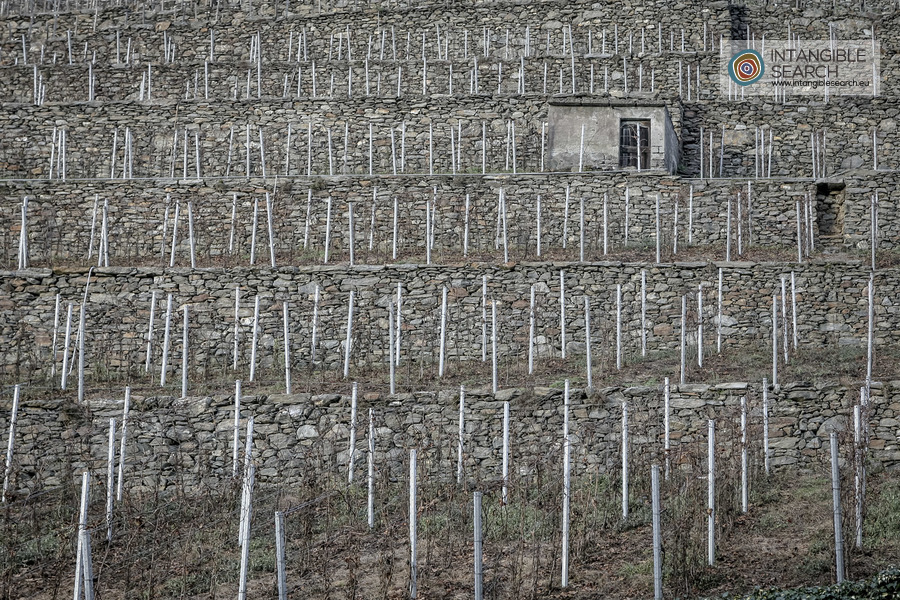
From Community
Tell us about it