-

Claudio Beltrami. Accordatura finale - Rossella Schillaci (frame video)
-

Claudio Beltrami. Precisatura - Rossella Schillaci (frame video)
-
2005


Accordion making. Claudio Beltrami in Stradella
Claudio Beltrami began working in 1976 at the "Fratelli Crosio Accordion Factory", where his father had also worked as a tuner. He worked in the different production departments and learned how to make the entire musical instrument. Learning how to make the reed blocks and the body was a particularly important part of his training. In 1978, he began his career as a tuner. In 1982, he opened his first tuning studio, which was used by the same local firms, including his former employers. In 1988, he began producing accordions under the brand "Beltrami Fisarmoniche - Stradella". The special feature of Beltrami products is the assembly of the reeds and the tuning of the musical instrument. The reeds are purchased from different firms which specialise in this product. The reeds are made from sheets of harmonic steel and are initially pre-worked to assign them a tone. This phase is known as roughing. During this phase, the thickness is standardised to give the reed the greatest elasticity and sound quality. The first tuning phase, known as "precisatura", involves assigning the predetermined note to the reed by comparing it with the diapason. The diapason and the sample notes are used at the tuning desk to compare which reeds need to be tuned. During this phase, the reeds are placed into a slot at the centre of a special table, known as a tuning table, with bellows operated by a pedal. The bellowed air vibrates the steel tongue of the reed and therefore produces a sound. You can then compare how close the sounds are. This work involves filing the reed to make it produce a precise tone: by filing at the tip or on the back of the tongue you can either raise or lower the tune. Then the pallets are assembled; once made of goatskin or natural leathers, they are now produced from synthetic leather. The pallets close any reeds that are not being played, so that air consumption is halved. Having initially tuned and covered the reeds, they are then assembled onto the wooden reed block. There are two techniques for this assembly: with wax or with rivets. The latter is best for producing a particularly contemporary and cutting timbre, which is perfect for playing outdoors and without amplification, situations that occur very often in the field of traditional music. On the other hand, the wax technique is recommended if you require a softer, mellower, less metallic sound; it also helps to keep the instrument in tune in the long-term. Then the pre-tuning takes place. This phase occurs when the reeds are already assembled onto the reed blocks. The reed block is positioned in line with the base and is attached to the bellows, which are operated by a pedal to make the reed produce a sound. The reeds previously tuned at the tuning table are inserted into the reed blocks and are then sent to the tuner, who begins the checks by using the diapason, starting from the lowest notes. Nowadays, Beltrami uses electronic devices to tune the reeds. However, some tuning is still done by ear, as is the case for vibrato and tremolo effects. It is only at this point that the reed blocks are mounted into the body of the musical instrument. This job is carried out by alternatively removing the reed blocks and then performing meticulous and continuous checks in order to achieve the final tuning. The final tuning is still done by the same methods as yesteryear, i.e. listening to the keyboard. Beltrami works together with the FISART factory in Marche, which makes the wooden parts, along with the Castagnari Company in Castelfidardo, which supplies the reed blocks, and last but not least with the Stradella studios, which specialise in the production of reeds. In 1985, Claudio Beltrami's wife joined the company, showing a particular talent for working on the reeds, particularly in the assembly of the reeds by using the wax or rivet techniques. The market for Beltrami accordions was initially aimed at local musicians, but now thanks to the Internet the market has expanded overseas. Beltrami accordions are currently exported to Europe (Switzerland, France, Spain, Luxembourg, England, Denmark and Norway) and to America (Arizona and California). The Beltrami firm produces between 30 and 50 instruments per year. The Beltrami Company pays particular attention to instruments for ethnic music, which require the widest variety of tuning: from the endless range of the "Musette" right up to the delicate and slow tuning of the "Americana". It is worth mentioning the Beltrami innovation of introducing individual control ranges on the bass sections that allow musicians to produce all the possible combinations of timbre, depending on the number of reeds they have chosen. Another one of the company's key features is its continuous technical research to provide cutting-edge products, such as the latest "COMPACT" models with their reduced weight and excellent handling, while still using high quality materials. These instruments with their typical lightness and ease of use are particularly suitable for the needs of traditional players.
LEARNING AND TRANSMISSION
Claudio Beltrami began his apprenticeship in 1976 at the "Fratelli Crosio Accordion Factory", where his father had already worked as a tuner. In the carpentry department, he learned how to make reed blocks, the wooden structure into which the accordion reeds are inserted, as well as the body of the instrument. Thanks to his remarkable skill, he worked in various production departments and got the chance to learn how the entire musical instrument is made. In 1978, while he was still working with the Crosio firm, he also began working as a professional tuner under the expert guidance of his father, who taught him the techniques of assembling and tuning the reeds. In 1980, he finished his professional training as a tuner at the "Musitalia" factory. In January 1982, he left the factory to open his own tuning studio.
COMMUNITY
Stradella has been synonymous with accordions for almost a century. The number of people employed in local companies, satellite activities and the cottage industry are proof of years of production among the entire community. The greatest period of expansion was in the 1920s when around 300 workers were recorded with Dallapè, 60 with Maga Ercole, 50 at Rogledi, several dozen with Massoni, 15 at Salas and 65 members and workers at the Cooperativa l'Armonica. The factories of this period were already famous around the world, where most of their products were exported, winning the most prestigious awards at international fairs in London, Paris, Rome and Marseilles. Between 1937 and 1945, over 1,200 people were involved in the construction of accordions out of a population of approximately 10,500, including those working from home. Straight after WWII, many other small factories and artisan shops were opened following the new expansion. The Crosio firm hit its peak with 107 employees; while following the recession of the early thirties caused by the 1929 global crisis, Dallapè employed 127 staff; and Cooperativa l'Armonica had over 100 workers. In 1950, in total there were 26 production outfits, employing about 500 workers with a monthly output of approximately 250 instruments. The cottage industry expanded, often involving entire families, who contributed in various ways to the production of accordions. Towards the end of the 1950s, various different factors caused the progressive decline of the industry, from changing musical tastes to the inability of small craftsmen to adapt to shifting market needs. By 1975, many were forced to close or convert their workshops into other businesses. From the 1980s, a few historic factories were still open, including Mariano Dallapè, run by his great grandson Amleto, "Maga Ercole" which was taken over by the tuner Luigi Trovabene, the Lucchini Company which was passed down to his grandson Antonio, and Fratelli Crosio, whose brand was purchased by the firm Music Pool. These factories were joined by three new artisan workshops: Elvezio Stocco, the grandson of Ettore Crosio, the tuner Claudio Beltrami and Marco Cagiada, another tuner. These are the only ones still in business today. These companies are all artisanal, and part of the manual construction process still survives; in particular, the Stradella tradition of working the reeds is passed on and still serves as the hallmark of accordions made in Stradella, making them much admired and famous around the world.
PROMOTIONAL ACTIONS
For years, the Municipality of Stradella has been working to enhance the profile of the accordion. It has organised events, concerts, exhibitions and music lessons for schools, while supporting and promoting the work of the "Mariano Dallapè" Town Accordion Museum.
To learn more
Bibliography
L’organetto. Uno strumento popolare contadino nell’era industriale
Bulzoni 1979
L’azienda delle fisarmoniche. aspetti di organizzazione di produzione e di vendita
Giuffrè 1958
L'albero del canto. Storie, mestieri, melodie - La casa della fisarmonica. Autobiografia di Amleto Dallapè
Formicona 1985
Material resources
The different models of accordions produced by Claudio Beltrami. A collection of handcrafted accordions and hand organs. A collection of musical instruments from the "Mariano Dallapè" Town Accordion Museum in Stradella. Several of the models owned by the Museum have been restored by Claudio Beltrami.
Produced by
Regione Lombardia - Archivio di Etnografia e Storia Sociale - Agostina Lavagnino
Release Date
29-NOV-2014 (Agostina Lavagnino)
Last update
02-DIC-2014
Tweet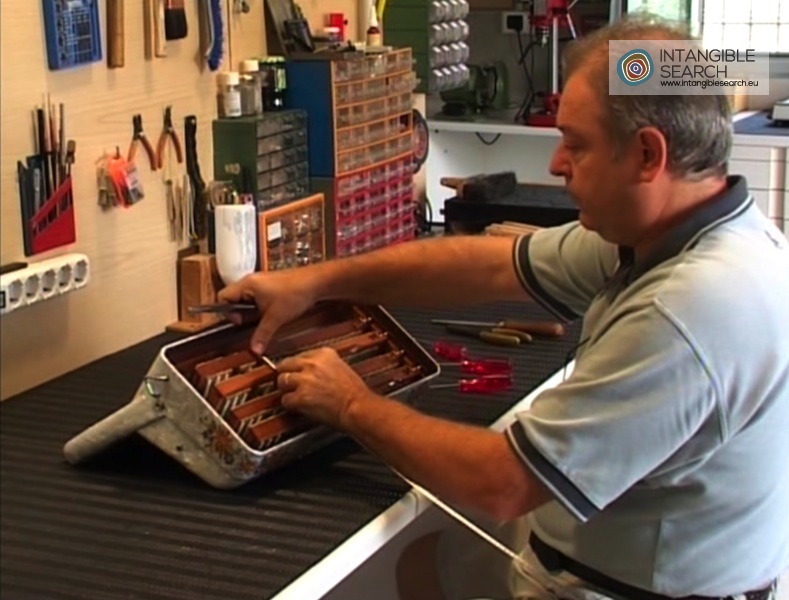
From Community
Tell us about it