-

Battitura nei campi - Da: G.Benetti, M.Guidetti, Storia della Valtellina e Valchiavenna, JacaBook 1999
-

Disposizione del menón sul plédru - Da: M.S.Compagnoni, I.Bonetti Testorelli, La segale, dai campi al mulino, dalla farina al pane. Centro studi alpini 1999
-

Incisione dei brece dégl per favorire la lievitazione - Da: M.S.Compagnoni, I.Bonetti Testorelli, La segale, dai campi al mulino, dalla farina al pane. Centro studi alpini 1999
-

Forme particolari di pani - Da: M.S.Compagnoni, I.Bonetti Testorelli, La segale, dai campi al mulino, dalla farina al pane. Centro studi alpini 1999
-

Sfornatura del pane - Da: M.S.Compagnoni, I.Bonetti Testorelli, La segale, dai campi al mulino, dalla farina al pane. Centro studi alpini 1999
-

Disposizione dei brecedégl nei latìn - Da: M.S.Compagnoni, I.Bonetti Testorelli, La segale, dai campi al mulino, dalla farina al pane. Centro studi alpini 1999
-

Pane per l'essiccatura sul resc-telét - Da: M.S.Compagnoni, I.Bonetti Testorelli, La segale, dai campi al mulino, dalla farina al pane. Centro studi alpini 1999
-

Panificazione domestica - Rivista locale
-

Panificazione domestica. Preparazione dell'impasto - Rivista locale
-

Panificazione domestica. Infornata - Rivista locale
-

Panificazione domestica. Il forno di Rita - Filippo Messina
-

Panificazione domestica. Il forno di Rita - Filippo Messina
-

Panificazione domestica. Il forno di Rita - Filippo Messina
-

Panificazione domestica. Il forno di Rita - Filippo Messina
-

Panificazione domestica. Il forno di Rita - Filippo Messina
-

Panificazione domestica. Il forno di Rita - Filippo Messina
-

Panificazione domestica. Il forno di Rita - Filippo Messina
-

Panificazione domestica. Il forno di Rita - Filippo Messina
-

Panificazione domestica. Il forno di Rita - Filippo Messina
-

Panificazione domestica. Il forno di Rita - Filippo Messina
-

Panificazione domestica. Il forno di Rita - Filippo Messina
-

Panificio di Berola. Cleto Della Valle - Laura Losito
-

Panificio di Berola - Laura Losito
-

Panificio di Berola - Laura Losito
-

Panificio di Berola - Laura Losito
-

Panificio di Berola - Laura Losito
-

Panificio di Berola - Laura Losito
-

Panificio di Berola - Laura Losito
-

Panificio di Berola - Laura Losito
-

Panificio di Berola - Laura Losito
-

Panificio di Berola - Laura Losito
-

Panificio di Berola - Laura Losito
-

Panificio di Berola - Laura Losito
-

Panificio di Berola - Laura Losito
-

Panificio di Berola - Laura Losito
-

Panificio di Berola - Laura Losito
-

Panificio di Berola - Laura Losito
-

Panificio di Berola - Laura Losito
-

Panificio Bresesti - Laura Losito
-

Panificio Bresesti - Laura Losito
-

Panificio Bresesti. Panificazione tradizionale - Laura Losito
-

Panificio Bresesti. Panificazione tradizionale - Laura Losito
-

Panificio Bresesti. Tecnica della famiglia - Laura Losito
-

Panificio Bresesti. Panificazione tradizionale - Laura Losito
-

Panificio Bresesti. Tecnica della famiglia - Laura Losito
-

Panificio Bresesti - Laura Losito
-

Panificio Bresesti - Laura Losito
-

Panificio Bresesti - Laura Losito
-

Panificio Bresesti - Laura Losito
-

Panificio Bresesti - Laura Losito
-

Panificio Bresesti - Laura Losito
-

Panificio Bresesti - Laura Losito
-

Panificio Bresesti - Laura Losito
-

Panificio Bresesti - Laura Losito
-

Panificio Bresesti - Laura Losito
-

Panificio Bresesti - Laura Losito
-

Panificio Bresesti - Laura Losito
-

Panificio Bresesti - Laura Losito
-

Black Rye Bread in Valtellina and in Val Poschiavo - Directed by Flavio Nani
-

Festa de Lo Pan Ner. Panificio di Berola - Community
-

Festa de Lo Pan Ner. Forno di CÃ Verina - Community
-

Festa de Lo Pan Ner. Mulino Menaglio - Community
-
Festa de Lo Pan Ner. Provincia di Sondrio. Edizione 2016 - AlpLab
-

Festa de Lo Pan Ner. Forno di Castello - Community
-

Festa de Lo Pan Ner. Forno dell'Esabela - Community
-

Festa de Lo Pan Ner. Forno di CÃ Verina - Community
-

Festa de Lo Pan Ner. Forno del Museo Vallivo - Community
-

Festa de Lo Pan Ner. Mulino della Rosina - Community
-

Festa de Lo Pan Ner. Mulino della Maria - Community
-

Festa de Lo Pan Ner. Panificio di Berola - Community
-

Festa de Lo Pan Ner. Mulino Menaglio - Community
-
1950


1960


2014


2016



2017


Rye bread production in Valtellina
(Al seghel de mont - Pan de séghel)
Rye bread, black bread, or as it is often known, "poor man’s bread", is a particular type of bread made of rye flour which still today is consumed throughout Valtellina. In the past, rye and buckwheat were the main grain crops of the valley. Since the 1960s, the transfer of many production activities downstream, linked above all to the processing of products, caused the abandonment of activities carried out in high ground: agriculture and the raising of livestock. In fact, the rye used today is mainly imported. Despite this, the Valtellesians continue to consume the rye bread, which, over the centuries, has maintained the same characteristics: a ring-shaped bread (brasciadèla) with a diameter of 15/20 cm. The most widespread technique for shaping brasciadèla is to roll a quantity of dough with the palms of the hands to obtain a sausage-shaped length of dough about 30 cm. long. This is then curved and the ends are joined by pressing one on top of the other, so as to form a ring-shape.
The ring-shape, still common in Valtellina, allows the use of a stick to hang these pieces, placed in dry and well ventilated rooms that allow it to be stored for months. The bread was cut into pieces thanks to an instrument called gramula and was softened in milk or soup. The dry consistency of brasciadèla makes it well-suited being carried throughout the summer on mountains and pastures. In addition to the brasciadèla, produced mainly in the area of Teglio, there is the rye bread of Berola, a hamlet of Ponte in Valtellina, where rye bread is traditionally made in the shape of a round loaf, dried by resting it vertically on special wooden racks.
There are still today two very different types of breadmaking activities, from the social point of view and thinking about the economic organization: homemade breadmaking, using district ovens or those still found in rural homes, and the made in bakeries. Homemade breadmaking, which was widespread in the past, is always been an exclusively female activity. Polinelli Lucinda explains: "the oven was lit ten days earlier, it is understood when it is hot at the right point because the interior vault is white colored. In every family there was a woman who could make bread ".
Often, one of the women in the family would be in charge of making the bread for the others, coordinating the work with other women of the district. Many homes were equipped with ovens and often nearby families took turns using the same oven. Those who made the bread, the evening before, brought the flour and wood for the oven. Who cooked his bread in the baker oven did not pay, but left some loaves, in proportion to the work. For about half an hour they would make the dough with rye flour, with lukewarm water, salt, mother yeast and a little dough of the previous batches.
The dough was allowed to rise overnight. The yeast (él levaa) consisted of a bit of bread dough left to acidise in a wooden bowl or in a soapstone pot (lavegiàt). Lucinda says: "Everyone, when they made bread, left the dough for the neighbor's yeast, I left it in the marna", a sort of wooden cradle where the dough was made. In the morning the women proceeded to the last dough and the proceeded to prepare loaves or ring-shaped breads. Roughly 18 loaves were placed in orderly fashoin on the wooden planks where they rested two or three hours before baking. They baked for roughly an hour. In one day, 3 to 5 batches were baked. First the “hen’s bread” was baked to remove the heat, made with crumbs and leftovers from the dough; then the rye bread and the panun (a type of rye bread consumed during the Christmas holidays, the ancestor of the Bisciola valtellinese, inserted when the baking was halfway done) and the sweet brasciadèla at the end. The bread was brought home and kept in a fresh place.
In Valtellina, the process of breadmaking at home has almost remained unchanged, although this practice is much less widespread due to the bans that make the use of home ovens illegal. Those who maintain this tradition do so in a very reserved form and turn the oven on only a few times a year. Women are the protagonists of a tenacious and reserved "resistance".
The activity of breadmaking is nowadays articulated in different directions, but the recovery of traditional breadmaking is increasingly widespread, producing more limited quantities but with a renewed focus on the local supply chain. In Valtellina the base of the dough for rye bread is the same, it changes the shape and the processing technique. The largest bakeries use 1 quintal of rye flour a day, but the average is 20, 30 kg. for those who produce it daily, others produce it once a week or on weekends.
HISTORICAL-ANALYTICAL NOTES
In Valtellina rye was the main crop, along with buckwheat. These two crops generally occupied the same fields in alternating cycles: rye was sown in October or November and harvested in June. Buckwheat was planted in July and harvested in October. Often these cereals were cultivated amid the wine varieties between one row and another and sown up to an altitude of 800-1,000 meters. Crop rotation was practiced, employing three crops in two years: potatoes, buckwheat and rye, with the advantage of using all of the plots without depleting them. The sowing of the fields with rye was done by men. The whole family then collaborated in bundling the sheaves and during the threshing. The threshing could be done in the fields, if it was complicated to transport it, or in the farmyards of the homes. An handmade rectangular hemp cloth (pelorsc) was stretched out on the ground. The harvest was laid out on top of this, and with the family members arranged alternating along the longer side of the cloth, they threshed the wheat. They threshing using the corbel, the fiel, a wooden stick, a couple of meters long, at the end of which was attached another cylindrical wood, larger and shorter, or a piece of leather. The shot was given first by a row and then the other, alternately. It could last even two or three days. The blow was delivered first by one row and then by the other, in an alternating rhythm. Often the threshing occurred jointly among all the families of the district. Every family would lay down their pelorscia, and they were all sewed together on the spot, to make one, very long one. The act of sewing the pelorscia together to thresh together was called “metter giù piazza", or “laying down a square”.
There were also a large number of mills, used by communities to grind their own harvest and produce wheat. In particular, there were numerous mills distributed along the Ronda Valley (also called “Valley of the Mills”), which separates the municipalities of Teglio and Chiuro. These mills were active until the 1950s. Today they are rather dilapidated and in disuse. Remains a witness to the existence, in 1886, of 523 water mills, spread out over 72 municipalities, which took care of the needs of Valtellina and Valchiavenna. The municipality with the largest number of mills was Teglio, with 38 mills (on the sunny side, more favorable to crops). Over the last half of the last century rye farming has disappeared little by little from the Valtellinesian area. This progressive abandonment has in the last thirty years also affected buckwheat farming . Only in recent years has there been a reintroduction of local buckwheat and rye, with an attempt as well to recover the stone terracing of the valley, halting the abandonment of these lands.
In the past, rye bread was cooked in village ovens only two or three times a year, and consumed during moments of public and private social life. In some areas, such as in the neighboring towns of Sondrio, it was breaded twice a month. Only in the larger centers were bakers who produced and sold bread; but in every village there were private or district ovens, one of the common goods spread throughout the Alps. Many homes were equipped with ovens and often nearby families took turns using the same one. The whole family was busy for several days. Each family used to bake for the most part 1 weight of flour (corresponding to 8 kg.) Usually made from wheat, which was bought, and from rye of own production. The female baker, usually owner of the oven, was the pivot of a social and productive network, characterized by a precise order of habits, appointments, exchanges and social rules.
LEARNING AND TRANSMISSION
Recently, the learning and transmission of this know-how is enjoying renewed interest. Knowledge and techniques are transmitted by family, but local initiatives are spreading and and baking courses laboratories are increasingly. The bakery ceremony was a real ritual. The dough is made with rye flour and a percentage of white flour, with a very high percentage of water, one of the elements characterizing the Valtellina rye bread. A very slow, long mixture, which lasts at least 30 minutes because it must incorporate the water, must be assembled and, unlike other doughs, is presented at the end of the spongy process. For Rita "during the mixing phase it is essential to check the time, the air humidity, the outside temperature and especially the moon". For Cleto Della Valle "with the waning moon the amount of water increases".
"The moon must be 'hard', that is, to the last quarter, so that the bread does not get moldy and does not put moths... and still the cracking of the dough is a sign of good leavening; finally, the small pile of white wheat flour, with which to mold the shapes before pushing them into the oven" (Museo Etnografico della Valfurva, Sondrio).
Luigi Cao explains: "The local bakeries follow two production lines. A traditional line with a kneader and a machine that breaks the dough. This production line is adopted by small bakeries that produce limited production of rye bread and it is their main product. On the other hand, a more complex line provides for the slowing of leavening and therefore the preparation process is postponed by computerized temperature and humidity control".
Today we are witnessing interesting forms of collaboration between schools and local bakeries which organize educational workshops on bread making, transmitting this knowledge to the younger generations.
COMMUNITY
Today, the bearers of homemade breadbaking are still women, who continue to use private ovens and are the custodians of knowledge handed down in the family. Those who still produce bread at home usually only light the oven twice a year: once in December and one in May or in June. The community of local bakers is today very active in the production of traditional rye bread. The Bakers Association of the Province of Sondrio, consists of 94 bakers, distributed throughout the territory. The type of Valtellina bakeries refers to the micro and small businesses. Almost all of them produce rye bread if not daily, at least on weekends. Luigi Cao, President of the Bakers Association says: "My father was involved in bakery since 1952, we have passed the fifty years of activity and I remember that, when I was young, my father once a week made ring-shaped breads, a total of 15 kg. of bread per week. When I took over the company in 1992 we made the same quantity, but every day. Now we have arrived at around 120 kg. of rye bread daily produced and the average of whom produce rye bread is 30 - 35 kg. There is a great interest in rye bread especially from the catering sector, outside the Province, but also on our territory." Some bakeries operating in the area of Teglio, San Giacomo and Tresenda bring rye bread in restaurants in Milan, once or twice a week.
This new interest in rye bread should not be overlooked also from the point of view of the agricultural supply chain and sustainable development. We are witnessing the reintroduction of local rye, with the recovery of terracing and dry stone walls, reactivating the use of techniques and specific production knowledge. Reintroduction of the crop have been successfully tested in Teglio by the Swiss Pro Species Rare Foundation. The local referent for seeds is Patrizio Mazzucchelli, with his farm Raetia Biodiversità Alpine of Teglio, which has been protecting, preserving and multiplying many cereals and varieties typical of the Alps for years; a sort of precious "seed bank" of the Alpine Regions. Some bakers, like Cleto Della Valle, and some farmers have resumed the sowing of rye, even if the quantities on the territory of Valtellina are very limited. The new generations consciously choose to safeguard ancient crops and rare plants, with renewed enthusiasm to promote biodiversity and to reintroduce alpine varieties adapted to mountain climates.
The ovens are also the protagonists of a renewed interest of young people. Fabrizio, Cleto’s son, after his studies as an agricultural expert, is learning the trade from his father. Other ovens initiatives are taking place in Teglio, even if the ovens are no longer firewood, but comply with current regulations. Rye bread becomes an "icon" of shared and practiced cross-border community and food culture. Also because because it is associated with the consumption of other local products, rye bread becomes the ideal marker of a dense local food production reality such as cheese or cured meats.
PROMOTIONAL ACTIONS
In recent years small farmers have begun once again to plant rye. The numbers are still small, for a production directed almost entirely towards self-consumption. The Municipality of Teglio has alotted some economic incentives to favor the reappropriation of farmlands against the advancing forest. Currently in the territory of Teglio 11 hectacres of terrain are cultivated (in rotation: rye, buckwheat, barley...). A partial return of these crops can be seen also in the territory of Ponte Trevisio and in the surrounding regions of Tirano.
The attention towards a reintroduction of the original crops present in the valley has aroused interest in recuperating also those aspects linked to traditional agriculture and the restoration of some historical mills, which are being reborn with the intention of placing them at the disposal of those who farm small, select quantities. The mills will not be renovated with a view to commercial purposes; rather, all the buildings will be restored for reuse in a touristic-museal, ethno-cultural key, allowing for a revisitation of the milling of rye and buckwheat. One example of this is the Menaglio Mill, which was purchased and restored by the Municipality of Teglio which has provided for a path that traverses the farming areas of buckwheat, barley and rye. The Menaglio Mill milled until 1985. Today it is reborn through the management of the Association for the cultivation of buckwheat of Teglio and traditional cereals. Another restored mill is located in Castello dell'Acqua. The Municipality of Berbenno has taken over and renovated the Mulino della Ghelfa.
The Punto.Ponte Association has initiated a project to certify the supply chain involved in the local production of these crops, called “Risc-Food”. The project identifies a series of products and crops belonging to the gastronomic history of the terracing area (pizzocheri, sciat, taroz, cropa, rye bread and fugascia). “Risc-Food” incorporates into the products with a local identity wheat and local prime materials produced and certified from the point of view of the alpine biodiversity, prepared and offered for the world of dining, catering, banqueting and Street Food.
The Union of Trade in Tourism and Services of the Province of Sondrio, with the Association of Bakers of the Province of Sondrio and the Federation Coldiretti Sondrio, promotes through the project "100% Segale Valtellina" the production of bread made of rye flour produced exclusively on the territory, in a natural way and without the use of pesticides. This is an experimental project involving a rye producer (Michele Pelacchi farm) and ten bakeries spread over the province of Sondrio, from Valchiavenna to Livigno. The production of bread made with 100% Valtellinese rye flour takes place for a limited period of time, considering the reduced amount of flour available, but every weekend it will be possible to buy the "Rye 100% Valtellina". This is an interesting project of a short and controlled supply chain that wants to revive the production of traditional rye bread.
The Association of Bakers of the Province of Sondrio takes part every year in the event held in Vigevano, in the Pavia Province, Pane in Piazza, where all the regional breads of the Lombardy region are presented.
PROTECTIVE MEASURES
The Slow Food Foundation has instituted in 2001 the Valtellina Buckwheat Praesidium, with headquarters at Teglio (SO). The Praesidium aims at reintroducing typical winter-springtime grains that precede the summer cultivation of buckwheat, that is, the emergence of dumega (an old variety of barley for soups) and above all the local variety of rye. Attempts at the reintroduction of the crop have also been met with success throughout Valtellina, with a consequent noteable recovery of the production of rye bread.
The Valtellina Bisciola is protected by the Geographic Collective Mark (GCM). The memorandum of the GCM Bisciola is dated 7 June 2013, promoted by the Chamber of Commerce of Sondrio in collaboration with the Association for the Protection of Bisciola and Bakery Products of the Province of Sondrio of Confartigianato. The Association of Bakers of the Province of Sondrio is also working to obtain the GCM for Rye Bread. According to Luigi Cao, President of the Association, "the best would be to use the rye produced on the territory of Valtellina, but the quantities of production are so limited that it will be almost impossible to have in the specification that the rye flour used is locally produced" .
"Lo Pan Ner" The Alpine breads is an Interregional Festival that have been took place since 2016, involving different Alpine Regions. The festival took place on the dimensions of a unique event, a safeguard project that was shared thanks to local communities. Ancient mills and ovens are reactivated each year to prepare bread, involving children and young people, Ecomuseums and Ethnographic Museums. The event is part of regional policies of Intangible Cultural Heritage Safeguarding.
To learn more
Web Sites
Material resources
Until 1980s Community ovens were still in use. They could be used for a fee and included the work of a female baker. The payment was in kind, and in relation to the quantity of bread produced. Important in the operation of the oven was to ensure the continuity of the yeast, leaving a raw loaf in the cupboard. Another use was to leave a ring shape bread for the next customer of the oven in a peg on the wall. "At least fifteen days before, people cut the wood that was split and exposed to the sun. The men followed the oven activities: it was necessary to heat it, using hard and resinous wood blocks. When the oven had reached a certain temperature, the embers were removed and the bottom of the oven was cleaned. Meanwhile, the women and children kneaded, modeled the bread shapes that, all lined up on a spruce axis, then passed to the baker's shovel, which put them in the oven." (Ethnographic Museum of Valfurva, Sondrio).
Produced by
Regione Lombardia - Archivio di Etnografia e Storia Sociale - Fabia Apolito
Scientific Advisor
Agostina Lavagnino
Release Date
27-GEN-2016 (Fabia Apolito)
Last update
18-APR-2018 (Agostina Lavagnino)
Tweet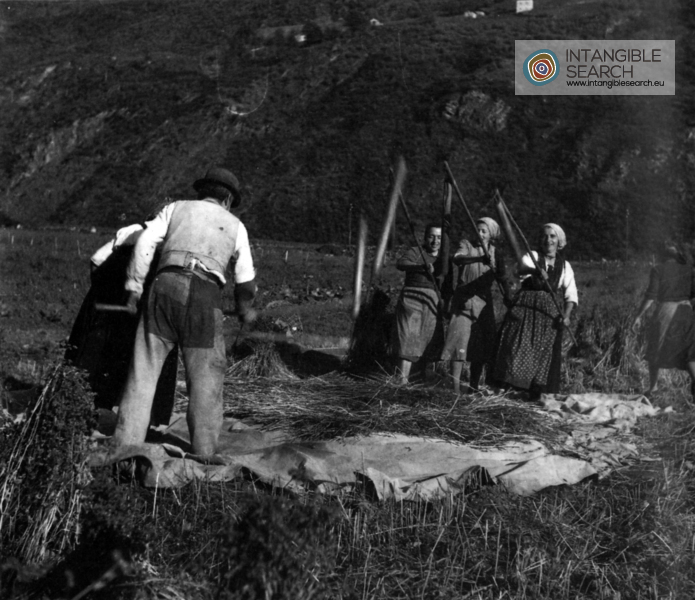
From Community
Tell us about it