-

Pareti nella cava di Isola - Edoardo Bricchetti
-

Ingresso alla cava di Isola - Edoardo Bricchetti
-

Fronte della cava di Isola - Edoardo Bricchetti
-

Il cantiere alla cava di Isola - Edoardo Bricchetti
-

Particolare della cava di Isola - Edoardo Bricchetti
-

La strada per la cava di Isola - Edoardo Bricchetti
-

Cava di beola - Maria Beatrice Servi
-

La cava di Splughetta - Sabrina Basilico, Luca Boriani
-

Divisone di blocco a scalpello - Maria Beatrice Servi
-
Estrazione del 'verde' di Montespluga - Sabrina Basilico, Luca Boriani
-
2011


2012




Stone quarry workers in Isola di Madesimo and Splughetta
In Valchiavenna, the Verde Spluga and Pietra Ollare quarries (trone) that extract two types of typical materials, remain active.
The stone called Verde Spluga is a fine-grained rock defined by a alight green colour, with varying tones according to the content percentage of the various minerals. It is very used in construction, also decoratively, for its aesthetic and mechanic properties.
The pietra ollare is a rock with a fine to medium grain, with a high percentage of talcum. It is used above all because of its excellent heat conduction and capacity to store heat. It is extracted in Piuro, municipality of Chiavenna.
In the open air quarry of Starleggia, property of the Valle di Starleggia, a variant of the Verde Spluga called Splughetta, a tone greyer, is extracted. The extraction is carried out traditionally and the sheets are hand cut, thanks to the schistose material. The consortium monitors this concession and encourages this extraction method, not too invasive and with minimised environmental impact.
The tunnel quarry of Isola di Madesimo is more extended. Historically this area had two quarries, one to the north and one to the south, not connected with each other. The quarry to the north is exhausted, since all the rock that was extracted open air has been completely exploited, since many years some tunnels have been opened in order to excavate the Verde Spluga. The quarry to the south is the only one functioning and the deposit remains only underground, due to the thickness of the recessed rock. The location of this unique extraction area is defined in the Piano Cave of the Provincia of Sondrio.
The extraction of the rock takes place trough the combined use of a diamond wire cutter and explosive. The cut of the chunks of stone (ciapòn) with the use of explosive, takes place by punching a series of wholes in the rock, five-ten metre deep, by means of pneumatic drills that perforate the material with steel points called fioretti.
The wholes are then filled with the explosive fuse connected to the detonator, it is set off and the explosion determines the separation of the rock.
The cut with the diamond wire uses the abrasive properties of diamonds. A steel cable, with small artificial diamonds attached, is passed rapidly around the rock. The cable similarly to a saw creates the cut by scraping it off. The utilisation of the diamond wire avoids producing vibrations and strains, common with the explosive method, therefore undesired breakages are avoided. Furthermore this process does not produce the explosion noise or the emission of harmful dust, which caused black lung (pucera), in the past.
HISTORICAL-ANALYTICAL NOTES
The exploitation of quarries has always been critical for the environmental balance and the dangers that exposed the workers. It has however always been any activity closely related to the mountain areas:
"In vast areas of the Alps the exploitation of mineral deposits has been together with agriculture one of the fundamental activities for centuries or even millenniums […] the connections between the mineral industry and the mountain are very close, since the mineral deposits are mainly located in mountain regions" places where the deposits were particularly rich, areas that were "often rich with woodland but not very important from a farming perspective" (P. P. Viazzo,Comunità alpine. Ambiente, popolazione, struttura sociale nelle Alpi dal XVI secolo a oggi).
In the valleys as well as the highlands the extraction of the gneiss was quite flourishing. Its manufacture required the workers to reside permanently in the mountains. "From the eastern side of the homonymous plain (m. 1763), dominated by thePizzo del Sancia, in proximity of the isolated tower bell, the steep path that goes to Starleggia starts. In 1931 a building that was used as a shelter for the workers at beola quarry was built; the quarry was located just below the ridge that extends from Pizzo del Sancia, towards the south, to Passo di Barna and to Pizzo Dalè, towards north, on the higher part of Val Fioretta (Valle di Starleggia)."(Massimo Dei Cas. Sentieri di Valtellina e Valchiavenna – Paths of Valtellina and Valchiavenna).
The quarry was up and running until a few decades ago, and then was abandoned. The structure was transformed in a camp, Ca' Bianca, restored in 1997 by CAI Vallespluga. On the right of the camp, a pair of posts is the only vestige of the cableway that took the stones from the cave to the plain of San Sisto.
Consequently to the rock extraction, masonry activities developed with the production of stone for construction, thresholds, frames, steps sills, decorative elements, etc. The stone sheets were sawed manually until most of the nineteenth century: towards mid century, the most innovative construction sites started using the water saw. The helicoidal wire saw and the industrial production would acquire more importance towards the end of the nineteenth century. Until then, the production of sheets and blocks, for steps, floorings, doorposts and lintels, was a task carried out by the master craftsman. The production always depended from the "vein" of the material that dictated the choice of dimensions and shape.
PROMOTIONAL ACTIONS
The Mu.Vi.S. of Campodolcino, dedicates an exhibition section to the work of quarry workers with old photographs (of the early 1900s), tools used for the extraction and processing of the stone and a short tract of cableway with its telephones, that were used to communicate from the top of the mountain to the bottom of the valley.
Related Intangible Heritage
Manifacture of soapstone items in Piuro
Stone roofs in the Alpine buildings
To learn more
Web Sites
Bibliography
Il Mulino 1990
Produced by
Politecnico di Milano - Dipartimento di Progettazione dell'Architettura - Maria Beatrice Servi
Scientific Advisor
Maria Beatrice Servi
Release Date
26-SET-2013 (Maria Beatrice Servi)
Last update
04-NOV-2014 (Fabia Apolito)
Tweet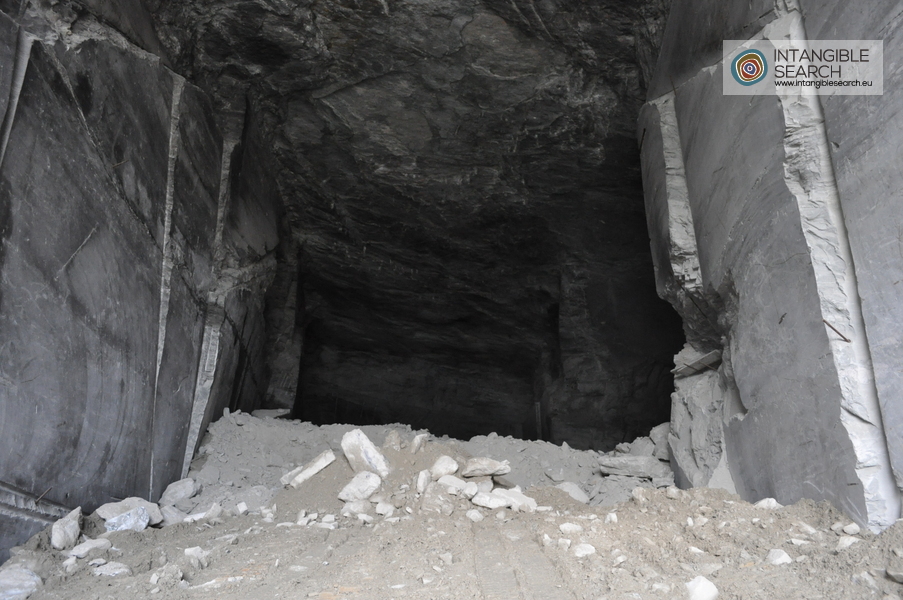
From Community
Tell us about it