-
Il ballo della Povera Donna
Ernesto Sala, Giovanni Meghella
-

Carnevale d'inverno. Locandina - Marta Gianotti
-

Carnevale Bianco. Brutto - Marta Gianotti
-

Carnevale Bianco. Moglie - Marta Gianotti
-

Carnevale d'inverno. Brutto e Povera Donna - Marta Gianotti
-

Carnevale Bianco. Arlecchini - Marta Gianotti
-

Carnevale d'inverno. Genitori della sposa - Marta Gianotti
-

Carnevale Bianco. Il ballo della Povera Donna - Marta Gianotti
-
1974

2003


2013

Indietro
Categoria
Riti e Pratiche SocialiTag
DOVE
Santa Margherita di Staffora (PV), Lombardia - Italia
QUANDO
Roman carnival
CHI


Carnival in Cegni
The carnival of Cegni, a village of Santa Margherita di Staffora in the province of Pavia, is held twice every year: during the winter (the Saturday before Lent) and in the summer (16th August) which is called Carnevale Bianco (White Carnival). The same rituals are carried out on both occasions: the procession, dancing which accompanies the wedding of the “brutto” (the ugly one) and the “Povera donna” (poor woman), dinner and the evening dance. The Carnival parade seems to be a direct parody of the wedding march and is made up, in addition to spontaneous characters, of a group of stock characters, each one of which interprets a special role. Brutto and his wife “Povera donna” are characters played by people. The “Povera donna” wears humble, peasant clothes, a shawl, and a scarf on her head. In a custom from past carnivals, she is at times transported on a wooden sled (called a lesa) that is drawn by a horse during the parade, evoking the transportation of manure on a travois. Brutto wears an ornate suit made of stripes of coloured fabric and a conic hat covered in fur, and he follows the horse-led parade. The couple is accompanied by other people: the secondi brutti (second ugly ones), being the parents of the Povera donna, who are just as poor, and who carry as a gift a chicken inside a basket; the terzi brutti (third ugly ones), the parents of the groom, who are instead dressed in a very elegant manner as citizens; the arlecchini (harlequins) or witnesses, who wear white clothes (old, everyday female blouses with embroidery and lace) with red belts, striped stockings, straw hats decorated with fabric flowers from which long coloured ribbons descend and they have to control the progress of the parade. These main characters are joined by the piffero and accordion players (typical instruments of this valley, the essential characters of the carnival) and dancers, above all children and young people, with mountain costumes, waistcoat and hat for the men, long skirts with apron and white ruffled blouse with black waistcoat for the women. The celebration begins on the Saturday before Lent.
In the early afternoon, the parade meets in front of the home of the Povera donna where the musicians play the stranòt, music that invites the bride to leave her house and begin the nuptial parade. The parade is opened by the musicians, who guide the group of dancers and the ‘carnival family’ through the streets of the town towards the main square. Along the route, stops are made in the yards of some houses, where food and drink are sometimes offered. Having reached the square, where the town-dwellers, those who live in the nearby villages and tourists are waiting, the local traditional dances begin. Known as the dances of the Quattro Province (four provinces), they are still alive in the area and are followed passionately by the inhabitants of Cegni. They are circle dances, such as piane, alessandrine, monferrine, dances such as polkas, jigs to be danced in two or four. In the culminating phase of the celebration, Brutto and his Wife dance the ancient Dance of the Povera Donna, a symbolic fulcrum and finale of the Carnival ritual. This is different from the other dances because of its pantomime content. It is part of the archaic thread of ritual dances that symbolise death and resurrection at Carnival. The dance is divided into three parts:- the first (in 6/8) is where the dancers move in space and seem to act out courting without contact
- the second part, called “lament”, is accompanied by slow music; the courting becomes physical with contact being made in the form of hugs and simulated kisses. The dancers bend their knees until they touch the ground and at times roll over
- in the third part (in 6/8) the dancers rise suddenly and carry out the “dance”.
The length of the dance varies according to the context, but the circular form of the three musical parts gives the musicians and dancers the chance to continue playing and dancing ad libitum. Seemingly true stories have arisen from the dramatized ritual: “..it’s the story of a jealous husband who pretends to die in order to test the faithfulness of his wife, and during the lament he sings “Oh, poor woman whose Tognin is dead”, but as he sees that she despairs, he jumps up and they begin dancing happily”, “…it’s a woman whose son has been killed, so she cries…and kneeling to the ground she despairs…and then sings “Oh, my two pieces of money, oh poor woman my Tognin is dead and she needed him so”, and then they get up and dance. There are some variations of this dance, which still appears during various festive and ritual occasions. Some variations are more formal in a choreutic sense, in others the spontaneous and grotesque aspects prevail, even though methods that are characterised and which can be traced back to “traditional” gestures can still be seen in them. The “theatrical” part of the Carnival ends with the pantomime of the Wife escaping, and being followed by Brutto. The episode recalls a legend according to which Brutto, the richest man in the town but not very good-looking, runs after the Povera Donna, who is beautiful but who loves another man. The carnival ends in the evening with a community dinner followed by dancing.
Cegni carnival was re-started only during the 1970s after an interruption of around twenty years, caused by the depopulation of the mountain areas in favour of urbanised centres. In spite of this, the carnival ritual in its current form contains the dynamic characters of a folklore phenomenon that is rooted in tradition and at the same time that is being reconfigured: on the one hand, to adapt to the changed conditions of the social fabric, and on the other to recover the expressive forms of the original ritual, which the young people learn of only from the memories and tales of the older generation. All this, however, is carried out spontaneously, as an answer to a deep need rather than as the fulfilment of a philological duty.
NOTIZIE STORICO-CRITICHE
In the period after the Second World War, while depopulation that broke up the community fabric of the towns and valleys was taking place, the traditional peasant culture and, as a result, also traditional rituals were forgotten. The carnival was interrupted for about 20 years. Only in the 1970s, thanks to some local Associations, did it return.
In the past, the ritual was carried out in a slightly different manner: in the period after the Epiphany, people went from door to door collecting rags that they used to make the carnival costumes. The ritual began in the morning. At around 10, the people of the town would meet in front of a house, in the upper part of the village, the place where the dancing started. Outside the town, different groups of festival characters would prepare to meet in the place where the dance of the Poor woman was to take place. At around 1 pm, even the children in costume would enter, together with the “arlecchini”, the “brutti” (the bride and groom), the “secondi brutti” (the bride’s parents), and the “terzi brutti” (the groom’s parents). The dance of the Poor woman culminated with the bride escaping, going to hide in a barn among the leaves. The “brutto”, who in the past wore a belt with cowbells, would enter the barn and pretend not to notice her, which would start a wild search through the whole town. Finally, the “brutto” would return to the barn and rake the foliage, digging out the fugitive. The couple were then loaded onto a sled for transporting manure and taken to visit the houses of the village, starting from the priest’s home.
APPRENDIMENTO E TRASMISSIONE
The participation of the whole community and above all the young people helps maintain and pass down the
ritual. The methods used to carry out the event remain substantially unchanged from year to year. The main stock characters, the brutto and the povera donna, have been interpreted for many years by the same people.
The dance, an essential component of the carnival, has its own functional dimension even in executive contexts that are different from those of the carnival ritual. During the whole year there are many occasions for dancing, in pubs or at dance celebrations, and it is there that the young people learn about the traditional dances of the Quattro Province area, guaranteeing their survival. It should be noted, however, that the dances and style that once had special characteristics and even substantial differences according to the various towns or valleys they were danced in have now become almost standard and identical everywhere, because of new communication methods, and awareness of the music and dances outside the traditional areas.
COMUNITÀ
The Associazione Quattro Province (Four Provinces Association) and the Associazione Oriundi organise the traditional carnival and its summer version, the White Carnival.
Many young people and children from the local community take part in both events, with the addition of many tourists and summer residents of Cegni for the summer version. The dancers and musicians come from nearby towns. The piper’s dance is still one of the central moments of the rituals and festive events that are held in the Quattro Province area. Groups of dancers usually tour to follow the performances of their favourite musicians, both during dancing festivals and in the more important rituals in the area of the Four Provinces.
AZIONI DI VALORIZZAZIONE
At the start of the 1970s, after a relaunch of the local cultural heritage connected with the carnival celebrations, the Carnevale Bianco, held every year on 16th August, was added to the traditional ritual. The summer reproposal aims at involving summer visitors to Cegni. Over these past years an attempt has been made to render this ‘performance’ more popular, even from an organisation viewpoint, in order to include it in the repertory of local tradition instead of making it become out of context.
Per sapere di più
Siti web
Bibliografia
Canti e musiche popolari dell'Appennino pavese. canti rituali, i balli, il piffero.
Associazione culturale Barabàn 1989
Pavia e il suo territorio
Silvana Editoriale 1990
A cura di
Regione Lombardia - Archivio di Etnografia e Storia Sociale - Fabia Apolito
Data di pubblicazione
22-LUG-2015 (Fabia Apolito)
Ultimo aggiornamento
19-SET-2017 (Agostina Lavagnino)
Tweet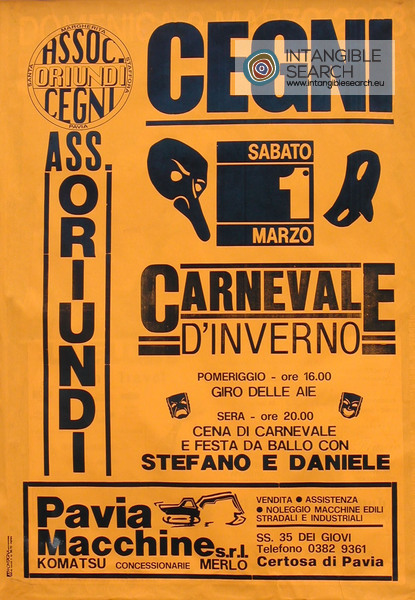
Dalla Community
Racconta