-

La preparazione di viloni e bresaole - Maria Beatrice Servi
-

Fase di lavorazione del violino di capra - Maria Beatrice Servi
-

Preparazione del violino di capra - Sabrina Basilico
-

Taglio del violino di capra - Sabrina Basilico
-
2011


2012
Indietro
Categoria
Saperi Tecnici e ArtigianaliTag
DOVE
Campodolcino (SO), Lombardia - Italia
QUANDO
Autumn-Winter
CHI

Production of the violino di capra in Campodolcino
(‘viulín de cavra o ‘carna seca’)
The 'Violino' di Capra (lit. translation "goat violin") is a typical hand produced cold cut that comes from Val San Giacomo. The cuts used are the thigh and shoulder of the goat, rarely of the row deer and chamois, which were once a rich traditional resource.
The meats are salted, dried and ultimately cured, initially in the open air and later in naturally aerated cellars. The end product could be defined as goat ham. Its name derives from its peculiar shape that recalls the silhouette of a violin, but also from the technique used to slice it: it is placed on ones shoulder and the knife is held as a violin bow and simulates the same movement. It is of course possible to slice it in a less spectacular way, placing it on a board similarly to the ones used to cut pork hams.
The Violino di Capra is achieved from the meat of goats breaded mostly in the province of Sondrio. They are farmed using traditional methods and roam semi freely, and their nourishment is a wild plants, herbs and bran mixture.
The size of the cut is around three kilograms for the thigh and one kilogram for the shoulder. If cured more, especially with a natural technique, for at least three months (the idea is one year), the Violino is particularly tasty. Traditionally it was cured inside the so called crotti, which were spaces (similar to grottos) created in the rocks. Its peculiar characteristics are the following: the meat is compact (it should by no means be to dry) and presents a vivid colour, it has a triangular looking and flattened shape. The small slices have a peculiar flavour, with an aromatic tinge. Clearly every recipe gives it a slightly different flavour, however all the meats are defined by the specific wild animal and smoked aroma that develops from the raw material and from its preparation. The goats must be selected carefully, cleaned and their nerves eliminated. The species of the animal is not essential, despite the Frisia or Fontalasca crossbred goats are preferred, and the main criteria of selection are they ways the animals have been farmed and fed. After this stage, the real preparation begins, it consists in salting the meat and letting it cure for around fifteen days. The Violino di Capra is normally seasoned with salt, pepper, laurel, clove and cinnamon. It is then cleaned and smoked rapidly, although the smoking process is controversial amongst the different producers. The last production phase, following the drying of the meat, regards the curing of the meat which should at least last three months. The meats are placed in rooms that should be chilled and maintain a constant temperature. During this period, the meat forms a fine layer of mould that provides a better preservation of the meat and can be easily removed with a humid cloth.
NOTIZIE STORICO-CRITICHE
The origin of the name Violino di capra is attributed to Giovanni Bertacchi, a poet from Chiavenna of the end of the 1800's. He mentions the Violino in one of his poems, which ends like this:
Che bèl imaginasel un poeta
che l vaga per al mont cont sto strümént
e l la distribuüìsa a feta a feta
per la gola e l piasé de tanta gent…
Che bèl vedé sto violìn che l möor
per diventà na müsica del cöor.
(In dialect, it talks about a poet that wanders around the mountains with his instrument, the violin, and then distributes slices of it to the people).
Val San Giacomo possesses morphologic features that have historically favoured and encouraged goat farming. High mountain animal farming attributes to the meats specific characteristics such as little amount of water and fats and a compact structure of the meats given by the intense muscular exercise. The animals grow particularly healthy even because of the rich herbs and plants, containing antioxidants and medicinal properties that are present at that altitude.
Pasture breeding in the high mountain is especially good for the end product because this environment is ideal for aging the meats. Traditionally the process would take advantage of the natural draughts and the autumn low temperatures.
The presence in various areas around Chiavenna of the so called crotti, splits in the rocks that had generated in the valley from prehistoric landslides, characterised by the constant flow of cold air, sorél, has favoured and spread the area of the production of the Violino to the whole territory of Chiavenna.
In the past the aging of the meats was done by exposing them directly to the draughts: there are stories about aging Violini seen hanging from the bell tower of Gallivaggio. The tradition considers the Violino as a festive food, generally consumed during Christmas. The way itself of cutting it with a knife, by holding it onto ones shoulder, together with the fact that once cu the first slice it has to be finished, suggest it is part of a convivial ritual.
There are many recipes of its production, all of which kept secret.
APPRENDIMENTO E TRASMISSIONE
Learning the tecniques takes places in the family, evn when the production is destined for trade, such is the case of the butcher shop Scaramella of Campodolcino. The preparation phases are quite standard, what varies is the salting and the smoking (the smoking is performed above all in Chiavenna) instead of the aging in the crotto. Today it is easy to find on the internet various recipes and suggestions to prepare the Violino.
COMUNITÀ
Nowadays families still produce the Violino. Recently its existence has spread beyond the traditional boundaries and the demand for some time has been higher than its offer. The most professional producers have taken the view not to increase the production, so to preserve the quality of the product. The quantity of meat available in the territory is in fact not very much, so increasing the production would have meant importing frozen meat from elsewhere. The choice was to keep this as a quality niche product that maintains its characteristic of typical product and expresses the local cultural identity.
AZIONI DI VALORIZZAZIONE
The Val San Giacomo Violino is protected by "Slow Food" specifically the one of three local producers, for example the Scaramella butchers, however this product is not safeguarded by a public body probably because of its limited weight on the market. The three producers have signed a set of rules and agreed to comply with the traditional techniques as well as utilising locally sourced goat meat.
Slow Food's attention is directed not only the end product, the Violino di capra, but also to the animals source of the meat. Slow Food aims to find and protect the breed that is best to produce the best possible Violino. The field of interest is therefore quite wide and many parties are involved: breeders, butchers, traders.
MISURE DI SALVAGUARDIA
The Violino di capra is in the list of the traditional foods from agriculture of the Regione Lombardia, (law reference: articolo 2 del D.M. 8 settembre 1999, n.350).
Beni immateriali collegati
Allevamento ovi/caprino a Fraciscio
The farming of scheep and goats in Fraciscio
Per sapere di più
Siti web
Beni materiali
Crotti: natural splits in rocks, used as cellars and spaces to age and conserve foods.
A cura di
Politecnico di Milano - Dipartimento di Progettazione dell'Architettura - Fulvia Premoli
Supervisore scientifico
Fulvia Premoli
Data di pubblicazione
26-SET-2013 (Fulvia Premoli)
Ultimo aggiornamento
12-MAR-2018 (Agostina Lavagnino)
Tweet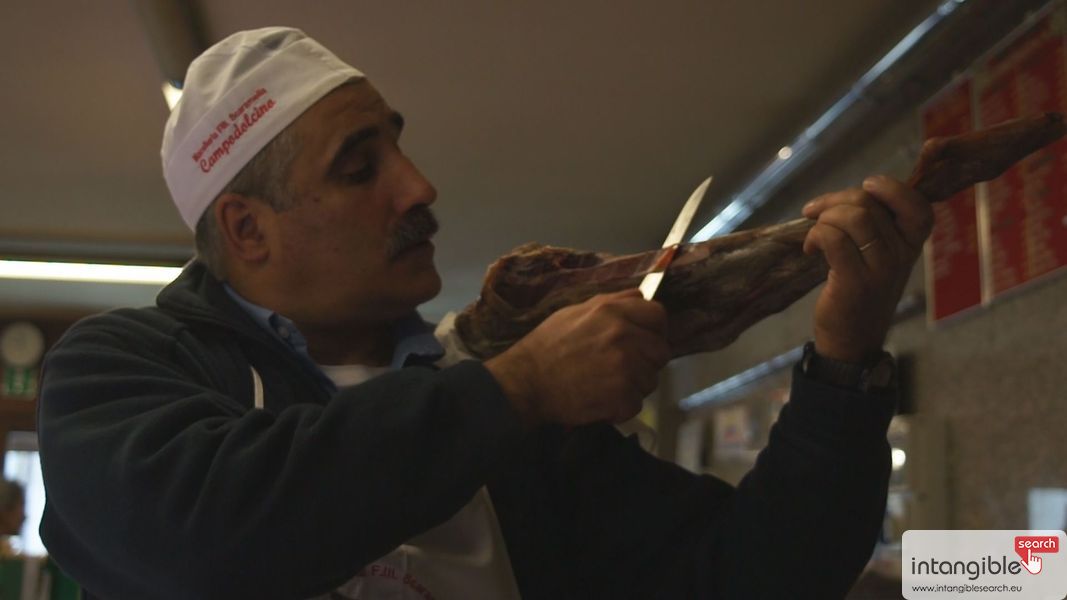
Dalla Community
Racconta