-

Carnevale di Bagolino. Segnacole - Scianna Ferdinando
-

Ballerini, carnevale di Bagolino - Scianna Ferdinando
-

Carnevale di Bagolino. Suonatori - Scianna Ferdinando
-

Carnevale di Bagolino. Bambini ballano in piazza - Scianna Ferdinando
-
partenza emanuel
Suonatori di Bagolino
-
spazzacamino
Suonatori di Bagolino
-
salt'im barca
Suonatori di Bagolino
-
mascherina
Suonatori di Bagolino
-

Carnevale di Bagolino. Ritratto di ballerino - Scianna Ferdinando
-

Carnevale di Bagolino. Ballerini. Un momento del ballo in piazza - Scianna Ferdinando
-

Carnevale di Bagolino. Ballo in strada - Scianna Ferdinando
-

Carnevale di Bagolino. Suonatori - Scianna Ferdinando
-

Carnevale di Bagolino. Ballerini - Scianna Ferdinando
-
ariosa
Suonatori di Bagolino
-
bal frances
Suonatori di Bagolino
-
tunina
Suonatori di Bagolino
-
biundina
Suonatori di Bagolino
-
francischetta
Suonatori di Bagolino
-
bas de tach
Suonatori di Bagolino
-
bussulù
Suonatori di Bagolino
-
pas in amur
Suonatori di Bagolino
-
rose e fiori
Suonatori di Bagolino
-
sifulot
Suonatori di Bagolino
-
muleta
Suonatori di Bagolino
-
munichella
Suonatori di Bagolino
-

Carnevale di Bagolino - Pierluigi Navoni
-

Carnevale di Bagolino e Ponte Caffaro. Ballerini - La Viola Marco
-

Carnevale di Bagolino e Ponte Caffaro - La Viola Marco
-

Carnevale di Bagolino e Ponte Caffaro - La Viola Marco
-

Carnevale di Bagolino e Ponte Caffaro - La Viola Marco
-

Carnevale di Bagolino e Ponte Caffaro - La Viola Marco
-

Carnevale di Bagolino e Ponte Caffaro - La Viola Marco
-

Carnevale di Bagolino e Ponte Caffaro - La Viola Marco
-

Carnevale di Bagolino e Ponte Caffaro - La Viola Marco
-

Carnevale di Bagolino e Ponte Caffaro - La Viola Marco
-

Carnevale di Bagolino - La Viola Marco
-

Carnevale di Bagolino e Ponte Caffaro - La Viola Marco
-

Carnevale di Bagolino e Ponte Caffaro - La Viola Marco
-

Carnevale di Bagolino e Ponte Caffaro - La Viola Marco
-

Carnevale di Bagolino e Ponte Caffaro - La Viola Marco
-

Carnevale di Bagolino e Ponte Caffaro - La Viola Marco
-

Carnevale di Bagolino e Ponte Caffaro - La Viola Marco
-

Carnevale di Bagolino e Ponte Caffaro - La Viola Marco
-

Carnevale di Bagolino e Ponte Caffaro - La Viola Marco
-

Carnevale di Bagolino e Ponte Caffaro - La Viola Marco
-

Carnevale di Bagolino e Ponte Caffaro - La Viola Marco
-
Carnevale di Bagolino - Elisa Piria
-
1971


1972

1973


1974
1975

1996


2010
Indietro
Categoria
Riti e Pratiche SocialiTag
DOVE
Bagolino (BS), Lombardia - Italia
Dancer and players parade walks along the town streets following an itinerary previously decided but which changes every year.
QUANDO
Roman Carnival
Carnival in Bagolino
In Bagolino there are two carnivals taking place at the same time but rather independent from one another. The first, more complex, abstract, and refined is the carnival of dances, dancers and musicians, which rolls on on the last Sunday, Monday and Tuesday of the Roman carnival. The second, with freer and seemingly more archaic features, is the carnival of the masks, that announces the arrival of the festival with parades throughout the village starting from January 5th.
For the community of Bagolino, Carnival is the most awaited moment of the year. It is endowed of a strong identity trait and it is a reason of pride for all participants.
The moment of greatest interest of the carnival is represented by dances that are performed in the streets of the town by a group of musicians and dancers, dressed with costumes and organized in associations that were born functionally to the ritual.
The orchestra is composed by a basset horn, violins and guitars in variable numbers, sometimes with the addition of a mandolin. The costume of the players is not fixed. They usually wear a normal suit with the jacket fringed cuffs, a red ribbon around the hat and a shawl over their shoulders.
The costume of the dancers is much more complex. They wear black trousers to the knee, decorated on their sides by a row of buttons or embroidery trimmings, white knitted socks, a white shirt and a black tie, a black jacket with white large fringed shoulder pads; all dancers wear white cotton gloves.
A large shawl with long fringes and vivid colors is fixed under the shoulder pads, tied to the throat and hanging on the back. With the dancing moves, shawls rise and fall in rhythm, adding an element of dynamism and color to the dance. A wide shoulder strap of embroidered silk goes from the right shoulder to the left hip: at the junction point of the two ends, it is fixed a large cockade (or two smaller ones) and from it two bows or pompom of different colors hang. A white frog hangs down from the left shoulder strap and goes to be fixed on the front of the jacket. From the wrists up, embroidery trimmings of various designs, called "ranks". The greater or lesser complexity of these decorations is given by personal taste and by the will of the individual dancer to wear a dress more beautiful than others.
The most distinctive feature of the costume of the dancers, though, is the headgear. It is a felt low dome hat, on which are sewn many meters of red silk which create a ribbons which fold on itself. The hat is completely covered by it. On this ribbon are sewn jewels of any kind (earrings, pins, hair clips, etc.). On the left side of the hat a big bow made up of silk ribbons of different colors can also be fitted.
The jewels affixed to the hat mainly belong to the family of the dancer, while others are borrowed from family friends. The work of "dressing" the hat, is performed by the women of the dancer's family, who begin this work a few weeks before the dance. When the carnival is over, the hat is "undressed", the ribbons are wound on bobbins to avoid damages and borrowed jewels are returned to their owners.
Dancers wear masks on their face with an identical form, with no marked traits and no expression, painted black in the area corresponding to the eyes; the rest is white. The unique hallmarks are two red spots on the cheeks, but they are only present on some masks.
The chief dancer does not have the mask, he wears a red necktie and a crimson ribbon on his left arm; his hat is black, decorated with an embroidered ribbon. Around his neck he has a small brass horn that he uses to gather the dancers. He does not take part in the dances. His task is to announce the titles of the plays, arrange the dancers and give them orders aloud. Typically this role is played by the same person for many years.
The dance steps and movements are fixed and nothing is left to improvisation.
The itinerary of the performances is planned beforehand. Generally they stop in front of the houses of people they want to pay tribute to or who requested it. The honored proprietors often offer the dancers a glass of wine or a cup of mulled wine in front of their main door.
The chief dancer is the person who decides which dances will be performed and announces them aloud.
The most well-known repertoire includes the following dances: Ariosa, Bussulù, Bal frances, Bas de tach, Biondina, Francischeta, Mascherina, Moleta, Monichela, Pas in amur, Rose e fiori, Saltambarca, Sifulot, Spassacamin, Tonina.
To each dance, in addition to dance steps, gestures are also associated. These moves are called "segnacole"; their meaning is still subject to different interpretations, but they remind of old figurative and drama characters.
The carnival of the masks, which takes place at the same time, has more extemporaneous, cheeky and irreverent characters. Young people who participate dress themselves up, often using costumes typical of the village. Knee-length trousers for men and long skirts for women, with long johns and woollen socks and often a cloak of rough material on their shoulders. These characters wear masks depicting them as elderly wrinkled people, they walk staggering, making a loud noise with their heavy clogs, the "sgalbèr", on the cobbled stones. Masks have playful approaches, often very explicit in their erotic nature towards the spectators, especially when addressing the opposite sex. They talk and scream in a falsetto voice, run and chase women and children, provoke, insult and annoy, sometimes they show their private parts by pulling up their dresses.
In addition to these masks, there are also the animal-like costumes, such as the rooster, the cow or the bear. They are often also masks representing jobs, characters and every day scenes.
On Tuesday evening, in a mainsquare of town, the carnival closes with the Ariosa, the last dance, which sees the dancers arranged in a big circle. The Ariosa dance, performed only at that time, it is highly looked forward to and shared, accompanied by shouts and encouragements by the audience who in this way greets the end of the carnival.
NOTIZIE STORICO-CRITICHE
The red spots that appear on the cheekbones of some masks worn by the dancers, are still a clear sign of the fact that in the past the group of dancers was divided into two. Men, known as "leaders", who wore the current costume and the white masks, and "women", with red cheeked masks, and whose costume was completely different: a white little skirt embroidered to the hem and a red cap, with a long blue tassel. "Leaders" and "women" - roles, however, exclusively performed by men – used to dance in pairs. Even today, despite having uniform costumes, the chief dancer divides the dancers in "Leaders" and "women".
In the past, players were paid for and the task of the chief dancer was to put together the best company that he was able to hire.
After 1970s, at which time the active participation in associations had suffered a sharp decline, today again companies of dancers are multiplying. There is also a company of children who can be up to 14 years old.
APPRENDIMENTO E TRASMISSIONE
For the inhabitants of Bagolino, to play an active role in the Carnival is an achievement of social prestige. There is a strong demand from especially young people to join the associations of dancers and musicians, so that the associations have the chance of choosing and selecting new recruits. The acceptance of an application and consequent enrolment into a group is perceived as a form of initiation. Once a young person is selected and accepted into the group, he/she will enjoy a certain respect and will be very proud to be part of it.
The passing on of traditional knowledge occurs especially within the associations of musicians and dancers, who get to match and cross their activities only during the carnival and its preparation. The rehearsals of the dances are numerous, as nothing is left to improvisation, and they are useful in particular to train new dancers. The chief dancer is a role of historical memory and he is the main instructor of recruits.
For technical reasons the group of musicians is much more fixed. The passing on of the instrumental techniques has always come with an oral and imitative procedure, even if today for the young players is not uncommon to attend a music school at the same time.
In general there is a tendency to inherit by family members the role played during the carnival. So there have been generations of families of dancers, players and masks.
COMUNITÀ
These carnivals involve the whole village, adults and children, who participate actively with different roles. Participation with an active role in the Carnival is a source of great pride and felt like an achievement of social prestige.
Bagolino inhabitants are fully conscious of the cultural value of their ritual and it is made clear by the seriousness, commitment and composure with which the musicians and the dancers perform their task.
The Carnival dances, their preparation and their implementation are fully entrusted to the dancers and musicians'associations. The latter have very different characteristics and interact only during the carnival and its preparation. In general, the participants are exclusively men, who perform also female roles, even though today there is a tendency to involve women in leading roles.
Dancers' families are involved in particular in the preparation of the clothes and in dressing of the hat, who start working on it for a few weeks before the event.
The carnival of the masks takes place in a much more extemporaneous way. There is no group to organize or lead the performances and activity of the masks. The participation is individual, the costume is not codified, the action is improvised.
Ponte Caffaro offers a carnival with very similar traits and Bagolino lives a fierce rivalry with it.
MISURE DI SALVAGUARDIA
The carnival of Bagolino is part of R.E.I.L. (Registro Eredità Immateriali della Lombardia - Register of Intangible Heritage of Lombardy), a project for treasuring, preserving and promoting intangible assets, traditional knowledge and ritual practices of the Lombardy Region.
Beni immateriali collegati
Carnival in Ponte Caffaro
Community luthiery in Valle del Caffaro
Per sapere di più
Siti web
Bibliografia
Brescia e il suo territorio - Il carnevale di Bagolino
Silvana Editoriale d'Arte 1976
Brescia e il suo territorio - I balli del carnevale di Bagolino
Silvana Editoriale d'Arte 1976
Il carnevale. Organizzazione sociale e pratiche cerimoniali a Bagolino.
Grafo Edizioni 1995
Il carnevale di Bagolino nei disegni di Antonio Stagnoli
Grafo Edizioni 1981
Beni materiali
Costumes of dancers and players, masks, musical instruments.
A cura di
Regione Lombardia - Archivio di Etnografia e Storia Sociale - Giulia La Marca
Data di pubblicazione
12-SET-2013 (Giulia La Marca)
Ultimo aggiornamento
21-GEN-2016 (Fabia Apolito)
Tweet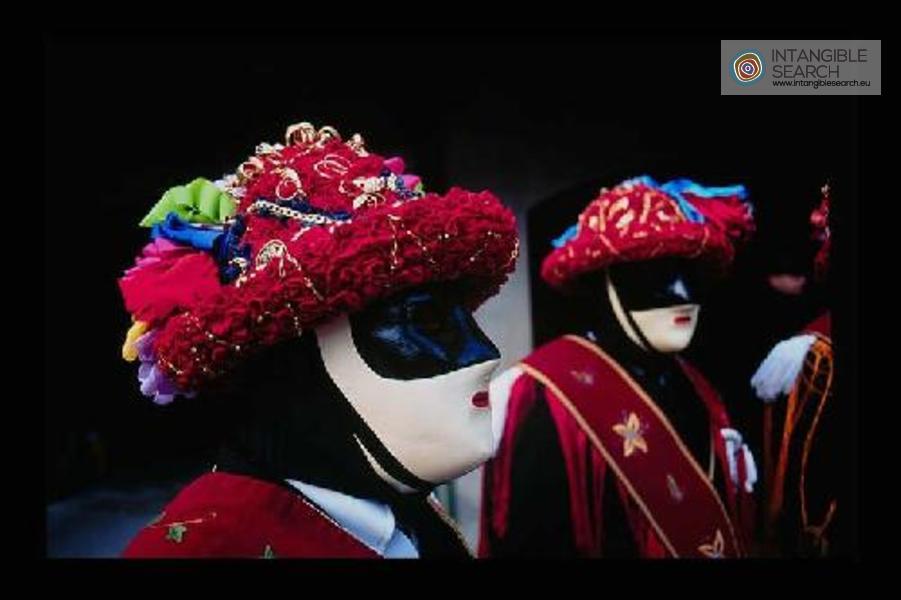
Dalla Community
Racconta