-

Passione di Vertova - Italo Sordi
-

Passione di Vertova - Italo Sordi
-
1976


Indietro
Categoria
Riti e Pratiche SocialiTag
DOVE
Vertova (BG), Lombardia - Italia
The procession starts from the parish church and goes along the streets of the village. Every year, it changes its itinerary so to reach different areas of the village. In comparison with the past, itineraries have been changed according to the village extension and to the building of new roads.
QUANDO
Good Friday
CHI

Vertova Good Friday procession
On Good Friday evening in Vertova, the laying down of Christ from the cross is represented through a huge procession in costume, with a large number of actors. This event is deeply felt by the inhabitants of the village, tourists and believers coming from everywhere. At the end of the via crucis -Way of the Cross which is celebrated inside the church, from the church entry steps the procession sets off. Several groups of people, playing a role in the parade, climb the stairs. At the back of it there is a group of men in costume, wearing red clothes and sophisticated hats. They represent the Jews and have the task to remove the Dead Christ statue from the cross. The statue is the artwork of Andrea Fantoni for the parish church. Two take him by his right arm, two by the left one and three by his feet; they lay him down on a small float and take him at the bottom of the stairs.
Many other people in costume take part in the religious procession: an altar boy carrying a big wooden cross, accompanied by many other altar boys and young people. Women are following and afterwards men, the Santissimo Sacramento Confraternity, wearing a white shirt and a red cloak, and the band. Then, groups of Roman soldiers "le Picche" follow; they are divided into three groups and have their spears/pikes in hand. Among the soldiers, the stretcher, on which the dead Christ is lying, is carried by the Jews. Four young men, dressed in black, carry four forks which let the Jews lay the stretcher down and take a break during the procession. Together with the last pica, there is an anonymous person, wearing a red sackcloth, a cowl, barefoot, with a heavy cross on his shoulders followed by a young boy wearing a white sackcloth, a cowl and barefoot.
The identity of this person carrying the cross is known only to the parish priest. According to the tradition, this person may have asked to do it as a form of expiation or as a voto for some favours required or received. The Third Picca closes the first part of the parade, accompanied by eight men carrying a torch. There are also believers, inhabitants of the village and pilgrims. Along the streets, many tealights are positioned forming big crosses which accompany the procession. Some bonfires are burnt in the nearby villages, visible from the streets of the village. When the procession ends, the statue of Christ is laid on an altar and shown to the believers who can kiss and pray. The statue is put back on to the cross the second Easter Sunday with a private ritual. On Good Thursday and Friday, bells stay put in mourning.
NOTIZIE STORICO-CRITICHE
In the past, on the float, on which the statue of the Dead Christ was laid, a canopy was positioned, carried by four men of the church. The canopy was then abolished because, in this way, the statue couldn't be seen by people looking out of their windows. During the procession, 14 small paintings were shown which represented the different Stations of the Cross. Many people were following carrying different objects, symbols of Christ's passion: the ladder, the cock, the nails, the hammer, Judas' bag, the crown of thorns, etc....many men and women, barefoot, were following the statue.
In the procession, there was also a big wooden cross full of lights, colorful pieces of glass, four lamps with symbols of Christ's passion. In the past, probably at the beginning of the XX century, the procession was followed by people representing characters such as Veronica, Maria Maddalena and other different jobs.
Saturday morning, Easter Eve, the parish priest was used to going from church to church to bless eggs.
COMUNITÀ
Among those taking part in the procession, there are pre-assigned some roles such as the first Picca and the Jews. The other roles are given through a public auction which takes place every three years in the parish church on Palm Sunday. On that day, left out roles as Forcelle, Torce, Picca the second and the third Picca are assigned. The decision about who is going to carry the "Crusù" is taken secretly by the priest.
MISURE DI SALVAGUARDIA
The Good Friady Parade in Vertova is part of R.E.I.L, that is Lombardia Intangible Heritage Register, a project aiming at treasuring, safeguarding and promoting the intangible heritage, traditions and rituals of the Lombardia Region.
Per sapere di più
Beni materiali
Wooden statue of the Dead Christ with adjustable arms done by Andrea Fantoni in 1725.
A cura di
Regione Lombardia - Archivio di Etnografia e Storia Sociale - Giulia La Marca
Data di pubblicazione
13-SET-2013 (Giulia La Marca)
Ultimo aggiornamento
21-NOV-2013
Tweet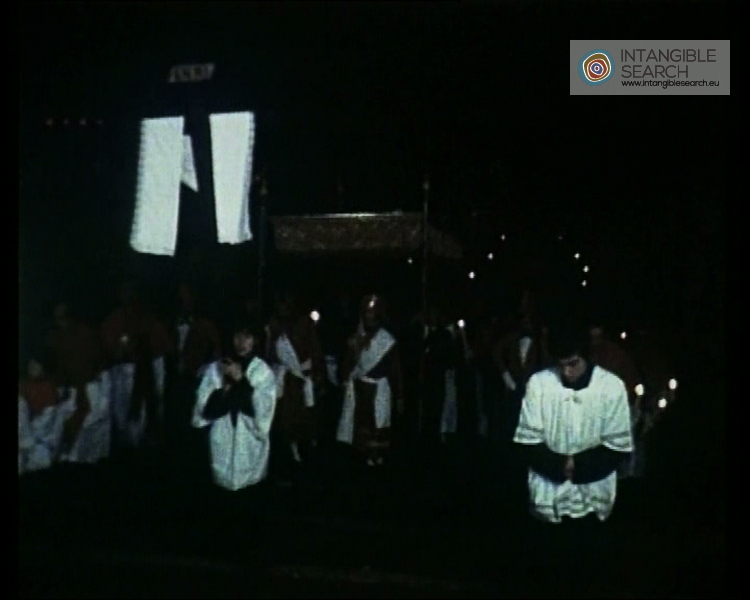
Dalla Community
Racconta