-

Sacra Spina di San Giovanni Bianco - Elisa Piria
-

Sacra Spina di San Giovanni Bianco - Federico Buscarino
-

Sacra Spina di San Giovanni Bianco - Federico Buscarino
-

Sacra Spina di San Giovanni Bianco - Federico Buscarino
-

Sacra Spina di San Giovanni Bianco - Federico Buscarino
-

Sacra Spina di San Giovanni Bianco - Federico Buscarino
-

Sacra Spina di San Giovanni Bianco - Federico Buscarino
-

Sacra Spina di San Giovanni Bianco - Federico Buscarino
-

Sacra Spina di San Giovanni Bianco - Federico Buscarino
-

Sacra Spina di San Giovanni Bianco - Federico Buscarino
-

Sacra Spina di San Giovanni Bianco - Federico Buscarino
-

Sacra Spina di San Giovanni Bianco - Federico Buscarino
-

Sacra Spina di San Giovanni Bianco - Federico Buscarino
-

Sacra Spina di San Giovanni Bianco - Federico Buscarino
-

Sacra Spina di San Giovanni Bianco - Federico Buscarino
-

Sacra Spina di San Giovanni Bianco - Federico Buscarino
-

Sacra Spina di San Giovanni Bianco - Federico Buscarino
-

Sacra Spina di San Giovanni Bianco - Federico Buscarino
-

Sacra Spina di San Giovanni Bianco - Federico Buscarino
-

Sacra Spina di San Giovanni Bianco - Federico Buscarino
-

Sacra Spina di San Giovanni Bianco - Federico Buscarino
-
2011



Back to search
Category
RitualsTAG
WHERE
San Giovanni Bianco (BG), Lombardia - Italy
The procession starts from the St. Giovanni Bianco parish church and goes along the main village streets crossing the bridges on the Brembo river and it goes back to the church.
WHEN
Lent, 5thSaturday and Sunday
St. Giovanni Bianco Holy Thorn
The celebration of the Holy Thorn ritual is an extremely important event for the Valle Brembana entire community. Every year, thousands of believers go on a pilgrimage. The celebration lasts for two days: the fifth Saturday and the sixth Sunday of Lent. During the days preceding the celebration itself, prayers, meetings, chants and liturgical celebrations take place. On Saturday evening, the town streets along which the processions will wind its way through are illuminated with thousands of red wax tea-lights. These lights are located also along the river banks, hung with a string to the bridges crossing the river and, the last year, even let float on the water in floating wraps. Families with childrentake part in the lightning and positioning of lights and they are coordinated by Mr. Carlo Rota, who is in charge for the illuminations of the feast. Besides tea-lights, the town is adorned with decorations and lights positioned on the houses, churches and bridges. A special light reflects the image of the Holy Thorn onto the Brembo river.
On both river banks, bonfires are lit and tens of fires are visible on the surrounding hills. On Saturday afternoon, the Holy Mass is celebrated in the Saint Giovanni Bianco's church. On that occasion, the relics are removed from the niche where they lie during the year, in the apsis on the left hand side church transept, and are shown to the believers through an illuminated shrine located behind the main altar. It is worth noticing that in the apsis, where the relics generally lie, numerous ex voto are hung and many others are visible in the corridor which goes from the church to the bell tower.
Several choirs,practicing in Saint Giovanni Bianco and coming from other small towns in the Bergamo area,sing along during all the celebrations. At the end of the Mass, the holy relics are kissed. The ancient bells are rung manually in the so called "allegrezza" tune, thanks to the device positioned on the top of the tower or with ropes. When the Mass is over, the church is still open so to let believers come in to pray, light a candle, beg for mercy and pay tribute to the relics. Underneath the colonnade outside the church, rosary beads, religious images and holy water are sold.
Bands play in the square situated in front of the church and entitled to VistalloZignoni, the legendary relics benefactor. The end of the Saturday eveningcelebrations is announced by fireworks. The festivity reaches its climax on Sunday. When the Mass is over, the procession goes along the town streets. It starts from the church and it is opened by the Bishop of Bergamo, carrying the shrine, followed by priests, the Mayor, the political Valley authorities, different confraternities' members, each of them wearing a uniform and a cloak of a different colour, the band and thousands of pilgrims. Each confraternity carries flags, candleholders, personalized crosses which, before the parade starts, fill up a church aisle.
The procession goes along the main town streets, crossing the Brembo bridges and along both river banks. Participation is very high. People carry banners, crosses and flags. Among these, there is a big cross on a canopy carried by a group of young people dressed in blue. Young girls march carrying violet cushions in their hands on which some objects,symbols of Christ's crucifixion, are lain, such as nails and a crown of thorns. It is worth mentioning a wooden cross which the population has decorated with crucifixion symbols, such as three dies, nails, a hammer and pincers, a ladder, a razor, a heart surrounded by a crown of thorns, a small shroud, a wooden hand, a wine glass, a spear and a cane with a sponge on it. On the top of the cross there is a wooden rooster. The back of the cross is decorated with painted scenes representing Jesus' passion. At the end of the procession, the Holy Mass is celebrated by the bishop who kisses the relics. Numerous bands usually play on the churchyard.
HISTORICAL-ANALYTICAL NOTES
Each wooden fragment, worshipped as relics, is called Holy Thorn because it is believed to be part of the crown of thorns worn by Jesus during his crucifixion. According to the tradition, Louis IX of France got the crown and gave it to the Notre Dame church in Paris. The Holy Thorn arrived at St. Giovanni Bianco, as the lore goes, thanks to a soldier, VistalloZignoni, to whom a statue has been dedicated and located in the square in front of the church. In 1495he fought during the Fornovo battle on the Tanaro river together with the troops of the Italian cities against Charles VIII, who came to Italy to re-establish the French authority upon the Reign of Naples. During the battle, Vistallo and his comrades entered the enemy camp and got a huge booty, among which the precious relics which VistalloZignani gave to the St. Giovanni Bianco church. Since then, the Holy Thorn has become an important object worshipped by believers. The devotion has increased in time further to some periodical prodigious phenomena regarding the relics.
In particular, the so called "blossoming" miracle related to the thorn is said to happen every Good Friday when it occurs on the 25th of March, the Annunciation Feast. This phenomenon is also attributed to other Holy Thorns, preserved in other Italian churches, as for example in Adria and Naples. The prodigious blossoming on St. Giovanni Bianco's Day stopped when, in 1598, the relics were stolen by Bernardo Arcaino, an ex- spinner and prisoner of the village. The Holy Thorn was found within shortly but since then the miracle has not occurred any longer. The relics' cult has become, anyway, one of the most important religious events in the Brembana Valley. After more than three centuries, during the night, on the 27th of March 1932, the blossoming miracle took place again. That year, Good Friday was on the 25th of March and the believers had spentlong time on preparing the event with wakes, prayers, fast days and penances. The miracle took place two days later, on Easter day. A commission, made up of Mons. Marelli, the Bishop, Mons. Bernareggi and Davide Brigenti, the priests of the church, was called on to examine the miracle and they stated it to be authentic. Dr. Paolo Bianchi, appointed as commission doctor, noticed on the relics " a red, blood, alive and humid stain which was about to spread out and it was visible, naked-eye, from one meter."
LEARNING AND TRANSMISSION
The Holy Thorn promotion is due to the parish church and to the Valley religious authorities together with local, political authorities.
COMMUNITY
The organization of the event is committed to St. Giovanni Bianco's church in cooperation with its municipality. Other associations take part in it, among which the Holy Thorn Group, a committee made up of volunteers who are responsible for the organization of the event and of its promotion. The ritual has a great importance in the Valley and on the event a lot of pilgrims and spectators, coming from all the small nearby towns, gather together. Many associations and groups take an active part in the organization of the event itself.
PROTECTIVE MEASURES
The Holy Thorn event in St. Giovanni Bianco is part of R.E.I.L, that is Lombardia Intangible Heritage Register, a project aiming at valuing, safeguarding and promoting the intangible heritage, traditions and rituals of the Lombardy Region.
To learn more
Material resources
Holy Thorn shrineA popular wooden cross on which objects, symbolizing Jesus' crucifixion, have been hung.
Produced by
Regione Lombardia - Archivio di Etnografia e Storia Sociale - Giulia La Marca
Release Date
17-SET-2013 (Giulia La Marca)
Last update
21-NOV-2013
Tweet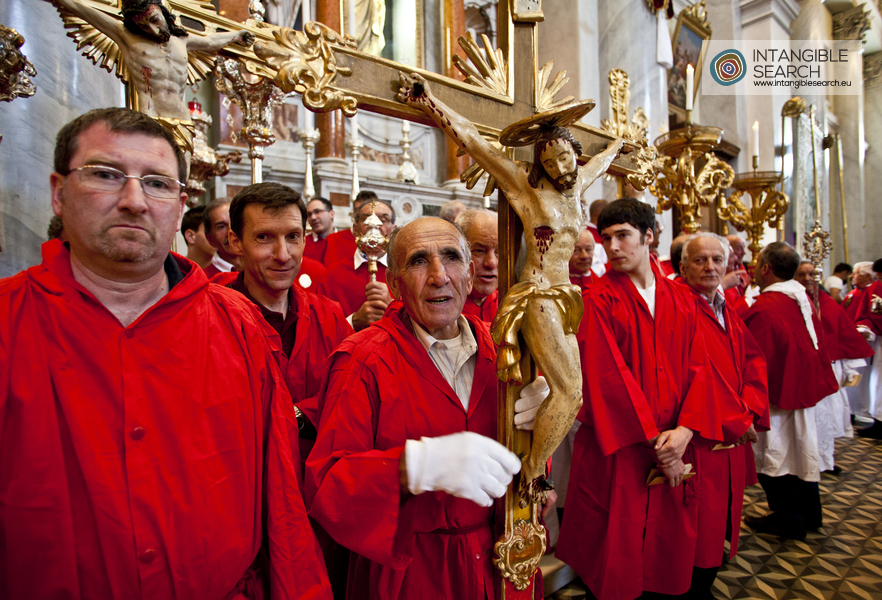
From Community
Tell us about it